

Asia-Pacific Markets - Latest Developments

IBC2025 is now open for registration, with the global media, entertainment and technology community set to gather at the RAI Amsterdam from 12–15 September. As the industry’s most important international platform, IBC drives innovation, collaboration, and real-world business success across the content and technology ecosystem. With a dynamic four-day exhibition and a three-day conference, IBC2025 promises to connect professionals from across the media and entertainment (M&E) landscape – from broadcasters and streamers to tech pioneers and content creators.

Decision makers and policy pioneers from the space sector will gather in Dubai to discuss trends and challenges in the new space economy at SATExpo Middle East 2025, which takes place from May 13 to 15, 2025, at the Dubai World Trade Centre (DWTC).
MarketBrief Report on the VSAT Market sponsored by Es'hailSat
Featuring:
The VSAT Market by Elisabeth Tweedie
Interview with Ibrahim Abdulla Al-Hammadi, Executive Director-Sales-Es’hailSat
Case Study on VSAT Mobility Network for Vehicle-Based Connectivity Solution
To read or download the pdf of full report click here.
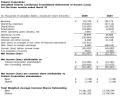
Satellite operator Telesat (Nasdaq and TSX: TSAT) today announced its financial results for the three month period ended March 31, 2025. All amounts are in Canadian dollars and reported under IFRS® Accounting Standards unless otherwise noted.

The late American comedian Robin Williams joked that politicians need to be changed like diapers: frequently and for the same reason. You cannot trust a human being who holds and builds-up that much power or authority for too long. Stuff that isn’t savory will inevitably accumulate.
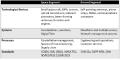
Here they are: WWWWWM – the five Ws and the One H – it stands for those familiar questions: who, what, where, when, why and how. You can ask Google or ChatGPT to define these and you’ll get some pretty good generic answers. These are the standard questions that according to journalistic practice should be answered by any article, preferably the lead paragraph. For our industry, these simple questions are not simple to answer, whether as a business or as a strategy:
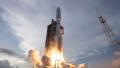
A United Launch Alliance (ULA) Atlas V rocket carrying the Kuiper-1 mission for Amazon’s Project Kuiper lifted off on April 28 at 7:01 p.m. EDT from Space Launch Complex-41 at Cape Canaveral Space Force Station. The Kuiper 1 launch marks the beginning of full-scale deployment of the Kuiper constellation and a new chapter in the commercial launch industry as Amazon partners with ULA to deliver a majority of its advanced satellites in low-Earth orbit (LEO).
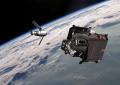
Space logistics and orbital transportation comapny D-Orbit, and Planetek Group, a provider of Earth Observation (EO), geospatial analytics, and mission software, announce a strategic business combination (merger) during an event held at the Sala degli Arazzi of the Ministry of Enterprises and Made in Italy, in the presence of Minister Adolfo Urso.
The April 2025 issue of the Satellite Executive Briefing is now available. Featuring:
The Military Satellite Market by Elisabeth Tweedie
Geo Satellites: Old Faithful by Bruce Elbert
Video via Satellite is Dead. Long Live Video via Satellite! by Robert Bell
Better Satellite World: Bringing Data Home from the Ends of the Earth
Plus Mergers and Acquisitions, Market Trends, Executive Moves, Vital Stats and many more. Click here to read or download the file
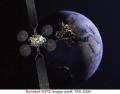
With all of the activity and associated hype of broadband LEO constellations, one wonders if there is anything left to say about GEO satellites and applications. I chose Old Faithful, that amazing geyser in Yellowstone National Park, as the theme for this article because it, like dependable geostationary platforms, can be relied upon to simply do its thing. Old Faithful is powered by natural causes much the way that a GEO converts sunlight into dependable services to and by fixed positions on the earth. It’s like man-made bridges such as Hells Gate in New York or the Golden Gate in San Francisco: little maintenance is needed, and for a GEO, orbital operations are the simplest of space missions.