



Asia-Pacific Markets - Latest Developments
 It’s hardly surprising that two topics dominated Satellite 2019 in Washington this year, were: the low earth orbit (LEO) constellations, and 5G. Topics that are constantly in the news, and are in fact related. Although many of the applications do not require it, low latency is one of the specifications of the 5G standard; therefore many operators feel that the LEO constellations are necessary for the satellite industry to be fully integrated into 5G.
Eutelsat Communications (ISIN: FR0010221234 - Euronext Paris: ETL) today reported slight increase in revenues of US$377.61 million (€337 million), up by 0.7% year-on-year for the third quarter on resilience of broadcast and stable video revenues. Revenues for the five Operating Verticals (ie, excluding ‘Other Revenues’), however, were down by 4%.
Rodolphe Belmer, CEO said the third quarter of 2018-19 saw the return to growth in Broadcast on a quarter-on-quarter basis, an improvement in the US Government renewal rate and commercial wins in Maritime Mobility.
 With transformation at the top of their agenda, business leaders are meeting at ConnecTechAsia, held in Singapore from 18 – 20 June 2019, to showcase and discover the latest technologies that promise to ready businesses for the future.
 The satellite industry calendar for May and June 2019 will see two key events from the GVF-EMP Conference Partnership portfolio taken firstly to Aberdeen in Scotland and then to London.
Telesat reported consolidated revenues of US$164.85 million (Ca$222 million) during the first quarter of 2019, a decrease of 4% or US$7.43 million (Ca$10 million) compared to the same period in 2018. But despite the drop, Telesat netted US$127.72 million (Ca$172 million) compared to a loss of US$11.14 million (Ca$15 million) in first quarter 2018.
 April 24 is China Space Day in China, a day more or less on par with Earth Day (i.e. a sort of non-holiday formal day of observation), and one which is met with a corresponding conference and exhibition, held in unconventional cities, including Harbin (2018) and Xi’an (2017).
The world is full of sharp disparities between the privileged and those struggling for access: access to good work, to knowledge, to the means to pursue their calling and preserve their communities. Around the world, dedicated people are using technology to close that gap. Technology that is literally out of this world.
Building a Better Future in Africa
The teleport industry got its start in the days when monopoly telephone companies ruled and, in the US, COMSAT was the sole gatekeeper for access to domestic and international satellites. Then the Reagan Administration’s Open Skies policy ended COMSAT’s lock on satellite access, and entrepreneurs jumped on the new opportunity.
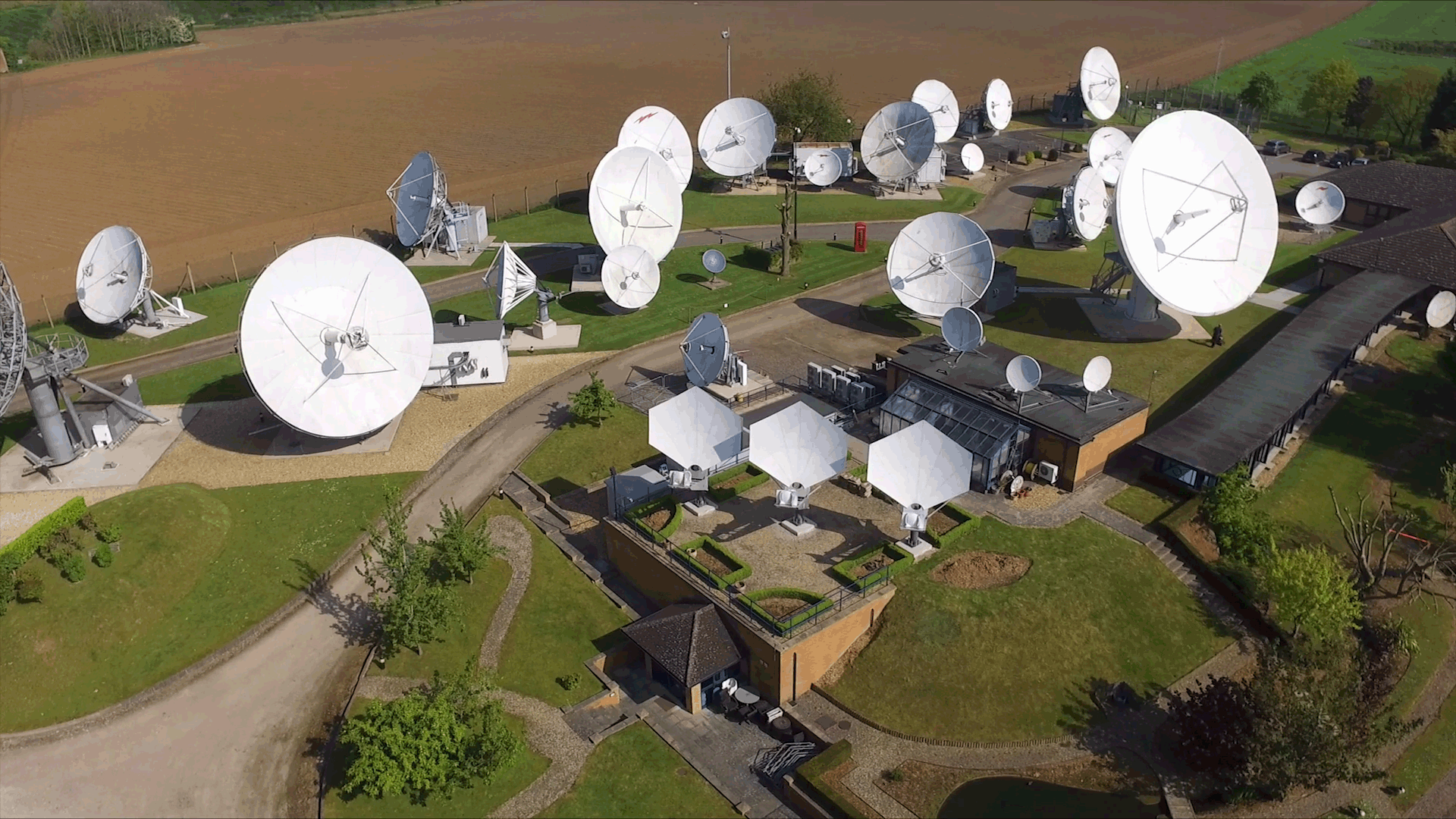 Having worked at a teleport at the beginning of my career, I never miss an opportunity to visit one. Teleports remind me of the very exciting times I spent working in one. There is something about the mix of high technology and innovative, geeky engineers that never cease to amaze me, so when I was invited to visit a teleport in England I didn’t hesitate to accept. But nothing prepared me for what I was about to see…
Intelsat S.A. (NYSE: I) reported today total revenues of US$ 528.4 million and net loss of US$ 120.6 million for the three months ended March 31, 2019.
Intelsat said EBITDA, or earnings before net interest, gain on early extinguishment of debt, taxes and depreciation and amortization, ofUS $ 372.8 million and Adjusted EBITDA of US$ 380.3 million, or 72 percent of revenue, for the quarter. Free cash flow from operations was US$ 24 million.