


Global Markets - Latest Developments
The World Teleport Association today released a new report, Delays in Occasional-Use Satellite Access. The report details results of a WTA investigation into problems reported by its members in gaining timely access to occasional-use satellite capacity. Based on survey responses from teleport operators and discussions with satellite operators, the report lays out the issues as well as offering preliminary conclusions and possible next steps.
NSR’s second installment of the Satellite Operator Financial Analysis study, released today, finds that the FSS sector remains robust in financial terms, with continued revenue growth in the outlook, while imminent IPOs and further industry consolidation (GE Satellite, KT Satellite) continue to shape the industry. In addition, the relatively recent and widespread trend of increased cost control is expected to improve margins further.
The Crowne Plaza Mutiara Hotel, Kuala Lumpur, will be the venue for the next conference in the GVF-EMP Oil & Gas Communications Series on 20th-21st November 2012. ‘Oil & Gas Communications South East Asia 2012: Re-Defining the Digital Oilfield – Onshore, Offshore, Deep& Ultra-Deep Water’ will be the 16th event in the global conference series, and will be held just as new hydrocarbons reserves are becoming accessible to the international exploration and production (E&P) environment.
With under one week to go until ITU Telecom World 2012 kicks off five days of critical debate in Dubai from 14 to 18 October, leading names from across the global ICT ecosystem are set to share knowledge and build consensus on the current profound transformation of the ICT sector, and its implications for the industry, for other vertical sectors and for the world in which we live.
NSR’s Global Satellite-Based Earth Observation (EO), 4th Edition report points to an industry in transition that is considerably improving its value-proposition. As a direct consequence, the satellite EO industry is progressively moving from growth fed by orders from governmental & military organizations to one based on a more balanced mix of end-users, laying the groundwork for a decade of growth in both data and value-added-services (VAS) segments.
With the number of people viewing online video via connected devices predicted to leap to 380 million globally by 2015*, OTTtv is at the forefront of connected entertainment and is undoubtedly an industry with huge potential. This provides the setting for this year’s OTTtv World Summit, where industry heavyweights Gerry O’Sullivan, SVP of Global TV and Entertainment at Deutsche Telekom, and Terry Denson, VP of Content and Acquisition at Verizon, will explore and debate whether telcos should build, buy or partner, in order to respond to this rapidly growing industry.
Put together Tooway, Exede, EPIC, Hughesnet, Hylas, Jabiru, NS3 and Clear Channel, and what have you got? You probably recognize the brand names, because of the accelerating pace of announcements about Ka-band satellites and higher-order modulation emerging from satellite operators and technology companies. And if they have given you the feeling that the satellite business is bracing for some big changes, you’re right.
According to the latest research from Informa Telecoms & Media released at the CDN Summit, revenue generated from the sale of content delivery network (CDN) services will grow threefold in the five years to 2017 to reach US$4.63 billion. This is on the back of a fivefold rise in global CDN traffic.
Compared to the ebullience of the last few years the mood was relatively subdued in Paris this September at Euroconsult’s Satellite Business Week conference.
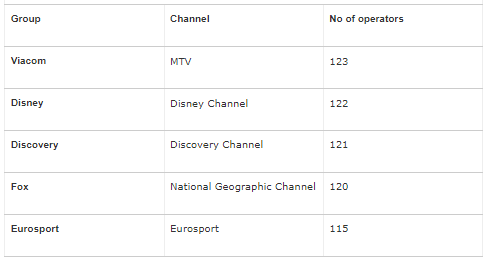
MTV is carried by more European operators than any other channel, according to a new report from Digital TV Research. However, the TV Channel Distribution in Europe report points out that several other channels are close behind.
Top channels carriage by number of operators