



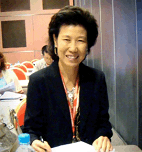
 "Dr. Nongluck,” as she is fondly called, joins the board of directors of the Society of Satellite Professionals International in March 2011. She spoke with SSPI Director of Development Lou Zacharilla on various issues, among which, one of her areas of focus on behalf of the international satellite community will be to further promote corporate social responsibility and enable more broadband service via satellite throughout the developing economies of Asia.
The guiding theme of the advertising agency where I began my career was “Make Human Contact.” It meant, simply, that any creative work that was done for a client needed to be written so that it touched people at the level where the human experience was most prominent. This idea set a tone that has been with me my entire career. That agency produced great work, including memorable themes for AT&T (“Reach out and touch someone”) and the US Army (“Be All That You Can Be.”)
Someone joked that until recently we have done everything we can in the satellite industry to create an international brand for one of the world’s most human industries that does just the opposite! We like to revel in our engineering and our technical excellence. However at the end of the day our contribution (and increasingly our bottom line) will gravitate toward what we deliver both in services and to the experience of two or more human beings attempting to use communications to “be all that they can be.”
Among those in executive leadership positions who acknowledge this is Dr. Nongluck Phinainitisart, the president of Thaicom. “Dr. Nongluck,” as she is fondly called, joins the board of directors of the Society of Satellite Professionals International www.sspi.org in March. Predictably, one of her areas of focus on behalf of the international satellite community will be to further promote corporate social responsibility and enable more broadband service via satellite throughout the developing economies of Asia. With rising living standards in Thailand, Cambodia, Laos and China, this strategic approach will have economic and marketing consequences. I caught up with her for dinner at PTC where we discussed this and other issues. She is as fluent discussing brand development for the industry as she is discussing throughput and compression ratios, as well as Eastern philosophy and basketball. Here are some bytes from our back and forth:
Lou Zacharilla (LZ): You have been the president of Thaicom since 2000. That’s a long run for an executive in the world of technology and communications companies today. What accounts for the longevity?
Nongluck Phinainitisart (NP): I have a commitment to the people in our organization and to the public at large. Thaicom is a two-decade old national project. It has many important aspects beyond business. When our organization has reached my goals for stability and growth, then I will know that it is time to leave and to pursue another mission.
LZ: That makes the job a vocation, which always drives a person higher. You also are an advocate for the industry as a whole. You served two terms as the head of APSCC (Asia Pacific Satellite Communications Council) and recently accepted the invitation to become a board member of the Society of Satellite Professionals International. It’s clear from our discussions that a major area of focus has been corporate social responsibility (CSR). Why is this an important area of focus for you and for our industry?
NP: CSR is the obligation that an organization’s management must make to take actions that will enhance the welfare and interests of society as a whole. CSR is quite important to society, the organization and the human experience. In our business, which really is about making human contact in so many ways, there are many ways to accomplish this.
LZ: I know that this also reflects, for you, a personal philosophy as well. There is the notion that looking at the long-term is a way for an organization to be long-lasting.
NP: Yes. That is true. And being a giver is better than be a receiver. It really does make you happy.
LZ: What is interesting is that sometimes we only realize this when the other approach fails. When that happens, we see shifts. Our thinking changes and next we restructure our organizations and even our cultures. I noted that in his recent State of the Union Address, the United States President, Mr.Obama, said that the USA needs another “Sputnik Moment.” He meant that in order to move to a new economy, which is obviously a mandate because the old one seems busted, there must be change. I interpret that to mean that technologies like the ones we offer the marketplace must be used creatively to reshape the economic landscape and create new avenues to wealth. Do you agree?
NP: Of course. The “Sputnik Moment” refers to the first earth-orbiting artificial satellite that was launched into an elliptical low orbit by the Soviet Union in 1957.
It ushered in a new political, military, technological and scientific era, according to historians. While the Sputnik launch was a single event, it marked the start of “the space age.” The American society underwent an enormous shift that emphasized science and technological research. Everything from Military to educational systems were revamped by the government and unimaginable economic possibilities became a reality many years later.
So conceptually I agree, but the devil is in the details. The challenge is how to implement any organizational or transformative shift successfully.
LZ: The emerging economy will be far more services based and will also mobilize commodities in a way far different than in previous eras. In many ways, the satellite industry will change the economics of transport by using its natural advantages, such as its ability to shrink distance, minimize the requirements of physical space and deliver from point to multi-point in big swaths. We now need to think long and hard about our role in enabling the constant proliferation of ideas into future markets and societies. That is also a form of social market responsibility. As I used to ask my parents after we pulled out of the driveway for a long family trip, “Are we there yet?”
NP: No. Not yet. We need to leap forward with our own research and development to connect the world wirelessly. The launch, satellite design and manufacturing, user terminals all have to improve or change to serve the next generation and to reshape the paradigm.
LZ: Regarding your responsibility to society, you have worked hard to bring Thailand’s youth closer to the digital age and its possibilities. What is your favorite program in this regard?
NP: Thaicom has been working with our partners to provide television sets and satellite receivers for Internet access to schools in mostly rural areas for a program called "Thai Kids Thaicom." Thaicom personnel literally go and visit schools and tell them about our industry.
LZ: What is the most important thing that our industry can do to enable more robust economies?
Many developing countries, including Thailand, have had good economic growth. Yet the question is how to make it sustainable. Wealth has to be more evenly distributed, not concentrated in cities. Satellite can play an important role in providing infrastructure to these needed areas quickly. We need to improve the overall cost structure so that we can pass that on to user. We need more innovation from satellite and equipment manufacturers.
----------------------

Lou Zacharilla is the Director of Development of SSPI. He can be reached at lzacharilla@sspi.org