



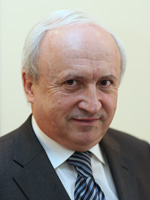
 Intersputnik’s Deputy Director-General and Chairman of the Board of Directors of the subsidiary Intersputnik Holdings, Stefan Kollar spoke to Satellite Executive Briefing on Intersputnik’s plans and how it will be facing the challenges in the new global commercial environment.
2011 will be the 40th anniversary of Intersputnik. How has your company evolved to meet the competitive challenges of the 21st century?
Stefan Kollar (SK): There are two main periods in the history of Intersputnik. The first period up to the early 1990s when Intersputnik functioned as an intergovernmental organization providing services to the governments of its member-countries and not too much commercial activities. The second period from around 1992 onwards focused on the commercial business, even as we still are an intergovernmental organization, the commercial part of our business has grown tremendously in comparison to the governmental business. To give you an idea of how we have changed, we have increased our revenues about 10 times since the early 1990s with consistent and stable growth every year. This is quite a substantial achievement for a relatively small company.
How did your company do in 2010 and how do you see your prospects in 2011?
SK: 2010 was not a bad year. We saw in the last five years a stable growth in revenues for our company of between 13-20 percent per year (depending on the year). In 2010 the growth was a little lower than usual but we still grew, I think 12 percent. 2011 is shaping up nicely and we think we will go back to our previous growth rates. We expect no less than 15 percent growth this year.
We understand your Board has made several important decisions recently. Can you share the highlights of these?
SK: Our Board has made some important decisions last year . One of which was the decision to build two new satellites to serve the interest of Intersputnik member-countries and if there is some available capacity for business and commercial purposes.
These new satellites will occupy the key orbital slots of 160 W and 780 E where they will be able to cover almost all of our member-countries in the coverage areas. The satellite at 160 W will mainly cover Europe and the satellite at 780 E will cover the Commonwealth of Independent States (CIS) countries in Eastern Europe, the Middle East and parts of Asia all the way to Vietnam.
Our Board has allotted 2010 and 2011 time frame to develop the best structure for Intersputnik to do business and explore ways of funding these two new satellites. We are not expecting that the new satellites could be fully financed by Intersputnik member-countries alone. So we are exploring partnerships with other operators and commercial companies.
We are now in negotiations with potential partners for this new venture. Before the end of the year, we will present again to our Board our vision and plan on how we intend to structure, finance and implement this project and move forward from there.
You are exploring partnerships with other operators and commercial entities for your new satellites, this sounds like your former venture with Lockheed Martin, LMI (Lockheed Martin Intersputnik). Are you considering spinning off another company?
SK: Something similar. But we don’t know what the legal status of the venture will be. It will be whatever we agree on. We don’t want too complicated a structure. We want it to be as simple as possible. But generally the idea is similar to what we did with Lockheed Martin.
What’s your timetable for launching these new satellites?
SK: The target set by our Board is to launch these two satellites by 2015, but we think we can accomplish this earlier. The reason is that the potential for business in these two orbital locations are really very good and there are several entities that are very interested in cooperating with us in this venture.
How different will your satellites be from those that are already out there. Will you focus on certain applications? Are you looking at Ka-band?
SK: For the first satellite, we will use the standard frequencies, that is C- and Ku-band, and the usual applications like VSAT networks and broadcasting. We have some frequency filings for Ka-band and if the market requirements justify it, we will consider it in the future, but not just now.
Apart for the two new satellite that you are planning, what else can we expect from Intersputnik?
SK: As you know, we have our subsidiary company Intersputnik Holdings which specializes in providing satellite services. We will continue to support their efforts to be more successful and by that I mean increasing our presence in the countries that we currently serve by adding new services and generating more revenue.
Our main focus in the next few years is to transform the company from a buyer and reseller of satellite capacity to a real satellite operator. Which means own and operate our own satellites. In the next few years we hope to be a strong operator of our own satellites and be competitive in key regions in the world. This will be the next important step as we face the next chapter in our company’s history.