


Los Angeles, Calif., March 10, 2026--Seasoned telecommunications and satellite professionals Krasimir Terziev and Bobby Kirchev started together Orbital Connect in 2020. In a relatively short time, they built the company into one of the leading channel partners and authorized distributors of leading global hardware manufacturers and are now offering ground segment and connectivity services, among others. Satellite Executive Briefing Editor-in-Chief Virgil Labrador caught up with Krasimir and Bobby at their company’s Los Angeles, California head office and discussed their company’s current position in the industry and their future plans. Excerpts of the interview follows:
It has been six years now since you both co-founded Orbital Connect. How do you see your company now and your position in the industry?
 |
|
|
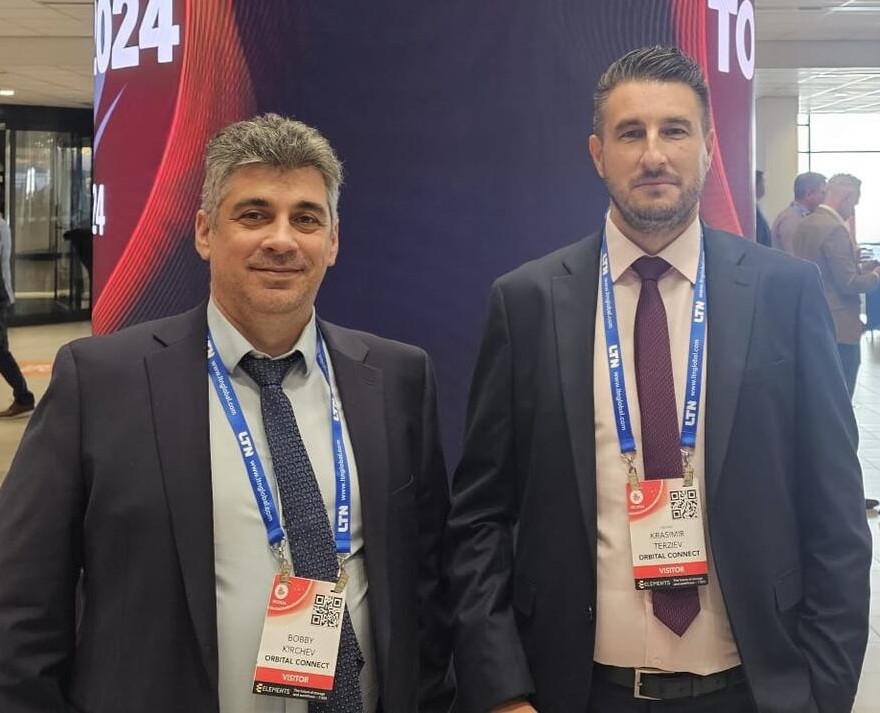
Bobby Kirchev and Krasimir Terziev |
Krasimir Terziev, PhD: We started as a reseller of RF equipment for the SATCOM industry. Our initial focus was on supplying products from selected leading manufacturers. Over time, as the requests and trust grew, we progressed to an authorized partner of some of the major players in the market. The goal shifted towards covering a broader range of ground equipment categories and helping customers procure reliable hardware in a faster and more efficient way.
Today, we are capable of delivering equipment, service, and technical solutions for more complex LEO, MEO, GEO, and HEO projects. Our portfolio includes satellite antennas, complete ground stations, and communication systems for land, maritime, and aeronautical applications. We deliver satellite VSAT antennas, radomes, modems, VSAT hubs, HPAs, LNAs, frequency converters, RF switching, RF over fiber, monitoring and measurement equipment, encoders, decoders, spectrum analyzers, broadcast contribution and headend solutions, as well as spare parts and accessories. We grew as a team, emphasizing engineering expertise and technical support. We assess SATCOM solutions suitable for applications across multiple sectors, including government and defense, maritime, energy, disaster recovery and first responders, education, transportation, and broadcast.
Among our key partnerships are those with companies such as iDirect, Kymeta, Norsat, Cobham, Intellian, Terrasat, Infinite, MediaKind, Calian, Global Invacom, Sat-Lite, WORK Microwave, Novelsat, and more. Witnessing how companies are looking for more than just the hardware, and along with the product, they often request integration, configuration, testing, and operational support, turned out to be a shifting factor for Orbital Connect. It drove us to seek partnerships with certified installation companies to provide deployment services across different regions. In the years ahead, we aim to deliver more technical solutions and add value to our clients. Currently, we represent more than 45 manufacturers and offer over 30,000 items. We actively collaborate with connectivity operators to deliver end-to-end LEO and GEO satellite connectivity including teleport uplink, downlink, turnaround, colocation, and IP delivery services.
Another key element of our strategy is to stay up-to-date with the trends in the Satellite industry. What we observe is the adoption of the multi-orbit concept. The industry is searching and working toward building a new paradigm for vendors, operators, and players. This will create an opportunity for new applications for the clients. Networks combine LEO, MEO, and GEO paths to guarantee uptime, bandwidth availability, and service continuity. Customers expect redundancy, security, and predictable performance. Technologies such as SD-WAN, virtualized infrastructure, and cloud-based platforms expand service capabilities and automation. Our strategy follows this shift. We provide converged satellite and terrestrial communication solutions rather than standalone products. The focus is on reliable connectivity, integrated systems, and long-term operational support.
You’ve recently added to your portfolio of services connectivity and teleport services. Talk about your connectivity capabilities and offerings?
Krasimir Terziev, PhD: Yes, we added satellite connectivity and teleport services through some strategic partnerships with established global operators. A good example is Speedcast, which operates more than 35 WTA-certified teleports and over 30 points of presence worldwide. Our goal is to e support customers by complementing satcom equipment supply with value-added connectivity and operational services. This includes supplying ground station and baseband equipment, performing system integration, and arranging colocation services at teleport facilities selected according to specific mission and operational requirements.
The approach is to provide customer support through the entire project lifecycle, from presales technical analysis and system architecture design, through equipment supply and integration, and into the satellite connectivity phase and operational deployment. This end-to-end involvement helps ensure consistency between ground infrastructure, network design, and service delivery.
Along with data connectivity, at Orbital Connect we provide professional broadcast solutions through cooperation with MediaKind and its cloud-native processing platform, Beam MK.IO. Using software-based architecture with scalable capacity and multi-format support, we offer encoding, decoding, multiplexing, and IP distribution services for channel delivery over both satellite and terrestrial networks.
Teleport facilities form the core infrastructure of satellite communication networks. With the rapid growth in the number of satellites in orbit, their role becomes increasingly critical for industry operations. They must therefore deliver high reliability, strong security, and continuous availability to ensure stable communication services.
What challenges do the new multi-orbit environment pose for ground equipment and ground services providers and how is your company helping other companies meet these challenges?
Krasimir Terziev, PhD: The transition to multi-orbit satellite networks introduces a new level of complexity for ground infrastructure and service providers. Traffic must eventually be routed across LEO, MEO, and GEO layers while maintaining stable connectivity and predictable performance, making compatibility and reliability fundamental design requirements.
Compared to traditional single-orbit systems, multi-orbit architectures introduce additional challenges related to satellite dynamics, frequent handovers, synchronization, and the coexistence of multiple waveforms and network policies. On the ground, these factors place increased demands on antennas, RF chains, modems, and network management platforms. Without careful system design and coordination, this added complexity can quickly translate into service degradation or operational instability.
From our perspective, one of the key challenges for industry is readiness. While large-scale multi-orbit deployments remain limited today, operators and end users are actively planning architectures that combine different orbits to improve resilience, coverage, and service continuity. This requires ground equipment and services designed with multi-orbit operation in mind, even when deployments are initially phased, selective, or use-case driven.
Orbital Connect is preparing for this expected growth by expanding its portfolio of multi-orbit-capable equipment and by developing internal expertise around system design, integration, and interoperability. We engage with customers at an early stage to assess requirements, evaluate architectural options, and identify combinations of antennas, terminals, modem platforms, and terrestrial integration that could support future multi-orbit operations.
As cloud-native platforms, SD-WAN, and virtualization increasingly influence satellite network design, we see our role as helping customers build a foundation that can evolve over time. Rather than positioning fully deployed multi-orbit solutions as a near-term norm, our focus is on enabling customers to make informed design decisions today, so that their ground infrastructure and service models are ready as multi-orbit demand grows and commercial deployments mature.
Can you provide us with more details on a specific case where you were able to provide a unique solution for one of your clients?
Bobby Kirchev: If I’m honest, the technology itself isn’t new. FoxCom has been doing GPS and Iridium re-radiation for hangars for many years, so this wasn’t about inventing something unique. What was important for us was the way we took responsibility for the solution as a whole, not just for supplying the hardware.
In these cases, the challenge for the customer was simply being able to perform normal maintenance inside large hangars. Even when an aircraft is parked, they still need GPS and L-band signals for avionics checks, commissioning, timing, and safety-related tests. Some of the hangars block those signals completely, so some form of indoor distribution is required.
Our role was to look at each facility and decide how the system should actually be implemented. That meant understanding the size and height of the hangar, where antennas could realistically be placed, and whether a single or dual repeater setup made sense. In some cases, cable lengths and losses pushed us toward fiber instead of coax to avoid signal degradation. Those are practical decisions, but they matter if you want a system that works reliably day to day.
For us, this was a good example of how our role is changing. We’re getting involved earlier, helping customers think through the design, coordinating with the manufacturer and installation partners, and making sure the solution is fit for the environment it’s going into.
How do you see your company going forward? What are your targets for this year and the coming years?
Bobby Kirchev: Looking ahead, I see our development very much around stronger integration between satellite and terrestrial networks. We expect more demand for solutions that combine satellite connectivity with 5G and traditional ground networks, and for architectures where connectivity can be managed more autonomously depending on what is available, whether that is GEO, LEO, MEO, or 5G.
Another important direction for us is the development of cloud-based solutions, particularly in cooperation with platforms such as Amazon Web Services and Microsoft Azure. What we see from our customers is a growing need for more complete, cloud-integrated solutions rather than isolated pieces of infrastructure.
At the same time, we are very realistic about execution. We’re not trying to do all of this at once. Our focus is on building these capabilities gradually, following customer demand and staying disciplined about what we can deliver well.
In the near term, one of our concrete goals for this year is to increase our involvement in government projects. We are working toward becoming a GSA contractor, which would allow us to support public-sector customers more effectively and in a structured way.
At the same time, we will continue the path we have already taken by expanding the number of vendors and products in our portfolio. This remains important for us, as it allows us to address ground segment requirements more comprehensively and to stay flexible when designing solutions for different use cases.
We also see strong demand from commercial customers looking for redundancy and diversification of their existing networks. In many cases, this means combining traditional telecom infrastructure with VSAT, OneWeb, and Starlink services.
Finally, an important part of our forward strategy is the continued development of our self-care customer portal, where customers can more effectively monitor, track, and manage their services. In this overall combination between hybrid connectivity, cloud integration, and better service management is where I see the direction in which Orbital Connect will continue to grow.
------------------------------------------
Read or download the full report on MarketBrief Report on Connectivity Solutions for the Multi-Orbit Satellite Market sponsored by Orbital Connect