


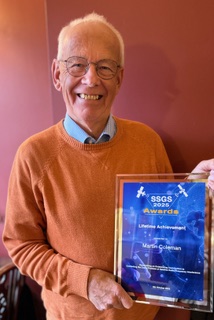
 At the Strategies in Satellite Ground Systems (SSGS) conference in London, this month, Martin Coleman, was given a Lifetime Achievement Award, recognizing his “Outstanding Contribution to Combatting the Costly Problem of Satellite Radio Frequency Interference.” As a largely unpaid volunteer, Martin has accomplished something that few others have been able to achieve.
From 2011 he brought together competing companies from all parts of the value chain, and cajoled, coerced and convinced them to work together to solve the issue of satellite interference. His work, has resulted in the creation of Carrier ID (CID), a defacto standard, incorporated into the DVB and ETSI standards as required by many countries including the USA.
No one thinks about interference until it happens, but when it does, it can be a major inconvenience and expense. According to a survey carried out by Newtec (now part of ST Engineering iDirect), 51% of operators experience interference at least once a month. With CID and other new tools, the time to solve the problem, went from hours/days, and sometimes even years, to minutes. More importantly the technology used to detect CID led to the introduction of a new tool to tackle the larger problem of VSAT networks which had plagued operators for years. This new technology also solved the VSAT Terminal RFI conundrum.
In 2017 alone, on behalf of the then IRG, Martin participated in (or chaired) 25 events on three continents. Most of those were funded from his own pocket and certainly on his own time!
His work did not end with the creation of CID and new tools. The proliferation of low, and to a far lesser extent, medium earth orbit satellites (LEO and MEOs) added a whole new dimension to the issue. With geostationary satellites, the problem is largely two-dimensional, pertaining to antenna pointing. As LEOs proliferated, it soon became apparent that interference between LEOs would occur, as well as LEO interference with GEO signals. The latter is beginning to occur more frequently.
Space Situational Awareness (SSA) concentrates on objects and debris in space. But problems are not confined to objects, Radio Frequency Interference (RFI), is now another situational awareness issue. Since 2019, through the Satellite Interference Reduction Group (SIG), that he founded, Martin has campaigned to recognize this, and look at the issue of space sustainability, as Space & Spectrum, Situational Awareness (S3A). It is no longer possible to deal with RFI in the same way as before, spectrum is on the move! During 2020 Martin spent nine months building an experimental system to orchestrate the monitoring of spectrum, and demonstrate the initial problems of RFI between LEOs, and occasionally between LEOs and GEOs. From this work a project called THRIMOS, a Three-Dimensional Radio Interference Monitoring System, was conceived, to provide real world data, in order to collect the statistics, recognize patterns and provide the analytics needed, to pave the way to build a global information repository on spectrum that could be shared by all operators in all orbits, so creating predictive traffic analysis so as to avoid RFI.
His name may not be as well-known as some in the industry, but the problem he worked tirelessly to solve with CarrierID, is. Now, with the number of LEOs increasing on an almost daily basis. It is only a matter of time before the problem of LEO interference with GEO signals turns into a major industry headache. When it does, Martin will be there with THRIMOS, and the experience, knowledge and insight, to shed light on the source of the problem, and suggest ways, to perhaps avoid the issue in the first place.