



In January U.S. Defense Secretary Robert Gates announced plans to cut $78 billion in defense spending over five years, including a reduction of up to 47,000 troops. These cuts are in addition to last year’s $100 billion cost-savings drive in efforts to eliminate waste, cut poorly performing weapons programs and redirect funds to other priorities. These announcements certainly appear ominous for industries such as commercial satcoms, which has seen increasing demand since 2001.
Upon closer examination of the details, however, the budget may not be decreasing as outlined over the short term. More importantly, even if the announced cuts are indeed undertaken in the short term or even the long term, commercial satcoms would appear to be unaffected and may in fact stand to benefit in terms of increased demand from the proposed cuts.
Here’s why...
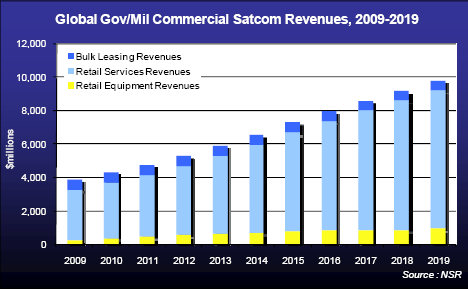 First, troop cuts as announced will take place starting in 2015. This means that defense spending for war efforts can and will likely continue to grow through 2014 before leveling off in 2015 and 2016. In fact, the $553 billion budget request for 2012 actually represents a relatively modest increase over the current fiscal year’s $549 billion. In terms of just pure budget discussions, the short term, specifically for 2011 to 2015, modest increases in the budget are foreseen. For commercial satcoms that are currently used by ground troops, demand should continue to grow at modest levels (as a baseline forecast) for the next four years.
Second, the 2012 Pentagon budget request excludes war funding, specifically for Iraq and Afghanistan. This means that cuts for specific programs will not apply to the two hotspots, which has seen continued growth for satcoms. Indeed, most of the government/military growth commercial satcoms has seen since 2001 can be attributed to developments in Iraq and Afghanistan as well as Pakistan, which is directly related to missions against the Taliban. Thus, on top of expected modest increases on the overall budget, war funding should continue at current if not higher levels through 2015 and perhaps beyond.
Third, a large percentage of budget cuts will come from inefficient programs, and funds available will be re-directed to other programs. A key program highlighted for support by Secretary Gates includes unmanned aerial systems (UAS); this is where the long term picture comes in. Even if budget cuts proceed beginning in 2016 or even earlier, and the majority of troops are withdrawn from Iraq and Afghanistan, UAS missions will not only continue but increase substantially as ground forces will have to be replaced by other means to gather intelligence. The UAS roadmap outlined by the Pentagon calls for a variety of new vehicles and capabilities, including the ability to cluster up to 12 cameras that can send up to 65 different images to different users compared to today’s capability of shooting video from a single camera over a limited area. Moreover, tactical missions similar to drone attacks in Pakistan are likely to be sustained, if not increased in the two major hotspots with troop withdrawals.
The call to cut the U.S. defense budget grows louder every year, and the Pentagon has heeded these calls to some degree. However, the situation on the ground has largely prevented cutting the budget in significant ways as engagement needs to be continued in order to win the war or (at a minimum) prevent the enemy from advancing any further.
Information for this article was extracted from NSR's report: Government & Military Demand on Commercial Satellites, 7th Edition