


by Markus Fritz
Luxembourg City, March 10, 2026--The vision of a seamlessly connected vehicle, one that maintains high-speed data, critical safety alerts, and operational telematics regardless of location, is transitioning from an R&D dream to a commercial and safety imperative. This demand for seamless, ubiquitous connectivity is colliding with a hard reality: terrestrial networks (TN), no matter how advanced, will never cover 100% of the globe due to economic and geographical constraints. The answer emerging from the collaboration of automotive giants, telecom leaders, satellite innovators and innovative space agencies is not a choice between ground and space, but a fusion of both. Hybrid Terrestrial-Non-Terrestrial Network (TN-NTN) connectivity, built on open 3GPP standards, is poised to become the definitive architecture for the next era of mobility.
Desirability: Defining the Sovereign Need – From Dream to Reality
.
The "why" is driven by a powerful combination of consumer demand, safety regulation, and strategic autonomy. Modern vehicles are increasingly software-defined platforms, reliant on over-the-air updates, real-time navigation, emergency call functionalities and audio/video streaming services. As the 5G Automotive Association (5GAA) notes, connectivity is the backbone for everything from emergency calls and hazard warnings to fleet diagnostics and in-car entertainment. A breakdown in connectivity is no longer just an inconvenience; it can mean a disabled safety feature or a stranded autonomous vehicle.
For BMW – “No connectivity is not an option”.
This need for "anywhere, anytime" coverage takes on a geopolitical dimension. In China we see Geely, the automaker building its own NTN Connectivity constellation via Geespace, and in the US Tesla will likely build its Space-based connectivity on Starlink Roam for in-motion use-cases. Looking at Europe, the push for sovereign, resilient communication infrastructure, highlighted by initiatives like the EU's IRIS², is not merely about commercial preference but seen as a strategic necessity. Reliance on non-domestic satellite constellations for critical connectivity introduces vulnerabilities. Consequently, a sovereign hybrid network model, where space-based components are integrated under regional oversight, is gaining traction as a core element of digital and industrial policy, ensuring that a continent's mobility heartbeat does not depend on a single, external source.
Feasibility: Architecting Interoperability with Open Standards
The feasibility of this hybrid model hinges on one critical factor: interoperability. The satellite industry's historical challenge of proprietary, bespoke solutions is being overcome by the wholesale adoption of 3GPP standards. By aligning NTN development with 5G and, looking ahead, 6G roadmaps, the industry ensures that a vehicle's modem can hand over a session seamlessly between a terrestrial tower and a satellite overhead without the user - or the application - noticing.
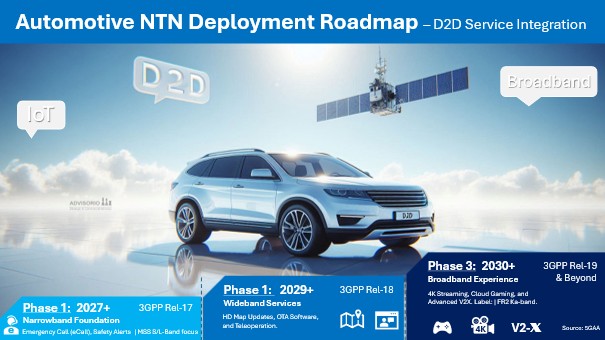
The 5GAA has been instrumental in driving this technical and operational alignment. Their detailed technical report outlines a clear NTN deployment roadmap for automotive, forecasting a phased introduction of services:
- From ~2027: Narrowband services (<400 kbps) for emergency calls (NG eCall), remote commands, and safety information via 3GPP Release 17.
- From ~2029: Wideband services (<10 Mbps) for HD map updates, teleoperated driving support, and software-over-the-air.
- From ~2030+: Broadband services (>10 Mbps) for advanced in-car infotainment and cloud-based applications. Although according to some Auto OEMs, Broadband service may be initially offered rather as an add-on or after-market service.
This standards-based approach has catalyzed tangible, high-profile partnerships, moving from MoUs to integrated solutions:
- Live Demonstrations: The 5GAA tech demos in Paris (May 2025) were a watershed moment. Attendees witnessed a BMW vehicle send emergency alerts via Skylo's network over Viasat satellites and experienced seamless TN/NTN switching for voice services orchestrated by Deutsche Telekom.
- Industrial Alliances: Strategic consortia are forming to deliver end-to-end solutions. For example, BMW Group, OHB System, and Deutsche Telekom have partnered to develop and demonstrate secure, sovereign satellite connectivity for future vehicles, directly linking automotive innovation with European space systems engineering.
- Strategic Investments: Automotive players are securing their technological access. BMW i Ventures' strategic investment in Skylo signals a deep commitment to integrating robust satellite IoT connectivity into future models.
- Software Integration: The ecosystem is maturing, with tier-1 suppliers integrating NTN directly into automotive-grade platforms. Cubic Telecom's connectivity platform and Harman (Samsung) with its ‘Ready Connect’ Telematics Control Unit are embedding NTN capabilities, making satellite connectivity a configurable software service for OEMs like Volkswagen Group, which has announced plans to equip its new Scout SUVs with integrated satellite connectivity.
- NTN NB-Voice becomes reality: A consortium including BMW, HARMAN, Qualcomm, Viasat, and Fraunhofer successfully demonstrated a live bi-directional voice call over satellite using Narrowband IoT (NB-IoT) networks. This test validates the capability of Non-Terrestrial Networks (NTN) to keep vehicles connected and maintain critical services in remote areas beyond the reach of terrestrial infrastructure.
Similarly, partnerships like AST SpaceMobile with Vodafone, Lynk Global or OQ Technology with multiple MNO partnership contracts are proving the core concept: standardized, direct-to-device (D2D) satellite connectivity is almost operational today.
The Critical Path: Spectrum Access and the D2D Advantage
A pivotal technical and regulatory discussion centers on spectrum access. For the initial wave of automotive NTN until at least 2032, D2D technology using existing vehicle modems is the most pragmatic and cost-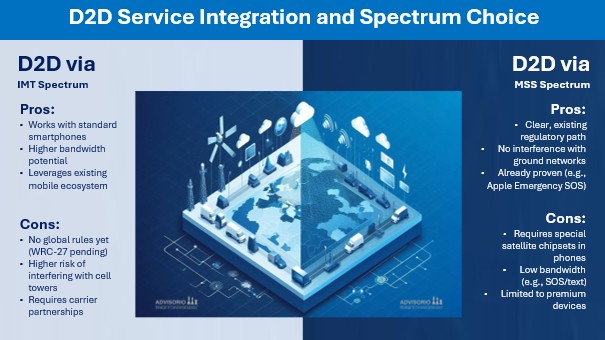 effective path. Here, two primary spectrum pathways emerge, each with distinct geographical advantages:
- MSS Bands (S-band/L-band): This satellite-dedicated spectrum is particularly suitable for regions with dense borders and complex regulatory landscapes, like Europe and Southeast Asia. Its primary advantage is the avoidance of cross-border terrestrial interference. A satellite beam over France can serve a vehicle without causing harmful interference to a terrestrial network in Germany, simplifying coordination. As noted in 5GAA's analysis, this makes MSS bands ideal for providing consistent, sovereign coverage across patchworks of small nations.
- IMT Terrestrial Bands: This approach, where satellites operate as "cell towers in space" using spectrum licensed to Mobile Network Operators (MNOs), shows great promise in large, contiguous markets like the US, or China. It leverages existing device hardware but requires intricate, country-specific agreements with MNOs and careful management to avoid interfering with ground networks, a challenge more manageable within a single large regulatory domain.
The choice is a strategic one: MSS offers regulatory simplicity and sovereignty for fragmented regions, while IMT offers potential hardware economies of scale in large, unified markets. The automotive industry, through 5GAA, is actively submitting refined antenna and terminal parameters to 3GPP (Release 19 and beyond) to optimize performance for both pathways, ensuring vehicles become first-class citizens in the NTN ecosystem.
Viability: Validating the Sovereign Economic Model
The ultimate question is of viability: Is there a sustainable business model? The evidence points to “yes”. The value is captured across the chain:
- For Automotive OEMs: Connectivity becomes a reliable, always-on utility, transforming vehicle capabilities and enabling new revenue streams from software and services. It mitigates the reputational risk of stranded vehicles and is fast becoming a competitive necessity.
- For Satellite Operators: It opens the vast, high-value automotive market of hundreds of millions of units - moving beyond niche backhaul and direct-to-home. It has the potential to provide a foundational, recurring revenue stream for LEO and Multi-Orbit constellation networks.
- For Mobile Network Operators: It allows them to offer a truly seamless "ubiquitous coverage" service tier, enhancing their value proposition without the prohibitive cost of building terrestrial infrastructure in ultra-low-density areas. And it offers an extra network layer of connectivity and resilience when terrestrial networks might be down – due to natural disasters.
The willingness to pay is embedded in the vehicle’s value. As connectivity shifts from a premium feature to a standard safety and operational requirement, its initial cost will be absorbed into the vehicle’s architecture, much like airbags or ABS once were. In addition, Auto OEM and Service Providers are going to deliver additional Value-Added Services to increase the overall ARPU of connected cars over the lifetime of the vehicle. The partnerships forming today are not just technical trials but commercial negotiations, structuring the revenue share models that will power this hybrid network economy along the value-chain.
Strategic Outlook
The convergence is undeniable. The satellite industry is no longer just providing a separate, standalone service; it is becoming an integrated, vital layer of the global telecommunications fabric, with the automotive sector as its first mass-market anchor tenant. The successful demonstrations, the clear 5GAA roadmap, and the flurry of cross-industry partnerships confirm the trajectory.
The journey to ubiquitous connected mobility will be built on the triad of desirability (sovereign, resilient service), feasibility (3GPP-standardized hybrid networks), and viability (shared-value economic models). For the satellite industry, this represents a historic pivot from serving the few in remote areas to enabling the essential for everyone, everywhere. The road ahead is hybrid, and it is being paved right now.
------------------------------
Markus Fritz is the Managing Director & Owner of ADVISORIO, a premier consultancy serving global leaders in telecommunications, space, automotive, smart mobility, and ICT. Markus Fritz advises on growth strategy, market development, partnerships, business models, and M&A, guiding corporations, scale-ups, public institutions, and think tanks in commercializing innovation. With 25+ years of executive leadership at SES Astra, Eutelsat, and Arabsat, he directed international commercial strategy, marketing, and strategic partnerships. A former board member of Digital Europe and ZVEI, and SAMENA Council Ambassador, he shaped policy and interoperability and open standards in the ICT industry. He can be reached at: markus.fritz@advisorio.com