



by Blaine Curcio
It’s a fascinating time to be covering the space and satcom sector in Asia-Pacific. On the one hand, APAC is one of the regions most rapidly adopting Starlink and other global infrastructure. On the other hand, in an increasingly multipolar world, many of APAC’s larger and more developed countries are upping the ante in meaningful ways by investing into sovereign space infrastructure. At the center of this contrast lies an important, multifaceted question: how to balance the desire for sovereign space assets and technology transfer with the high costs and long-term timelines of such solutions? Over the course of May and June, I attended conferences in Jakarta, Singapore, and Daejeon (South Korea), giving three different perspectives on these questions.
The Indonesian Case
The APSAT Conference in Jakarta is the premier annual Indonesian satcom conference. Held in May with copious amounts of Batik clothing, and organized by the Indonesian Satellite Association (ASSI), the conference brings together Indonesian satellite operators, service providers, and a growing number of companies in the earth observation, cybersecurity, and broader space domain.
This year was, admittedly, my first time attending, so my analysis can be taken with a grain of salt, but several topics stood out. First, the tension between reliance on Starlink and desiring domestic capabilities in the satcom domain was on full display. Over the past several years, Indonesia has undertaken perhaps the most ambitious universal service obligation (USO) program of any country in the world, the BAKTI program, initially envisioning connecting 150,000 rural sites using satellite. The CEO of the BAKTI Program, Fadhilah Mathar, was a speaker on the Indonesia satcom panel, where he noted that today, there are nearly 32,000 sites connected to Satria-1, a large Geostationary-High Throughput Satellite (GEO-HTS) operated by domestic satellite operator Pasifik Satelit Nusantara (PSN). This represents a major win for domestic capacity, self-sufficiency, and sovereignty.
However, during the same panel, Pak Mathar noted that since their entry into the market justunder two years ago, Starlink has captured 45% of the Indonesian satcom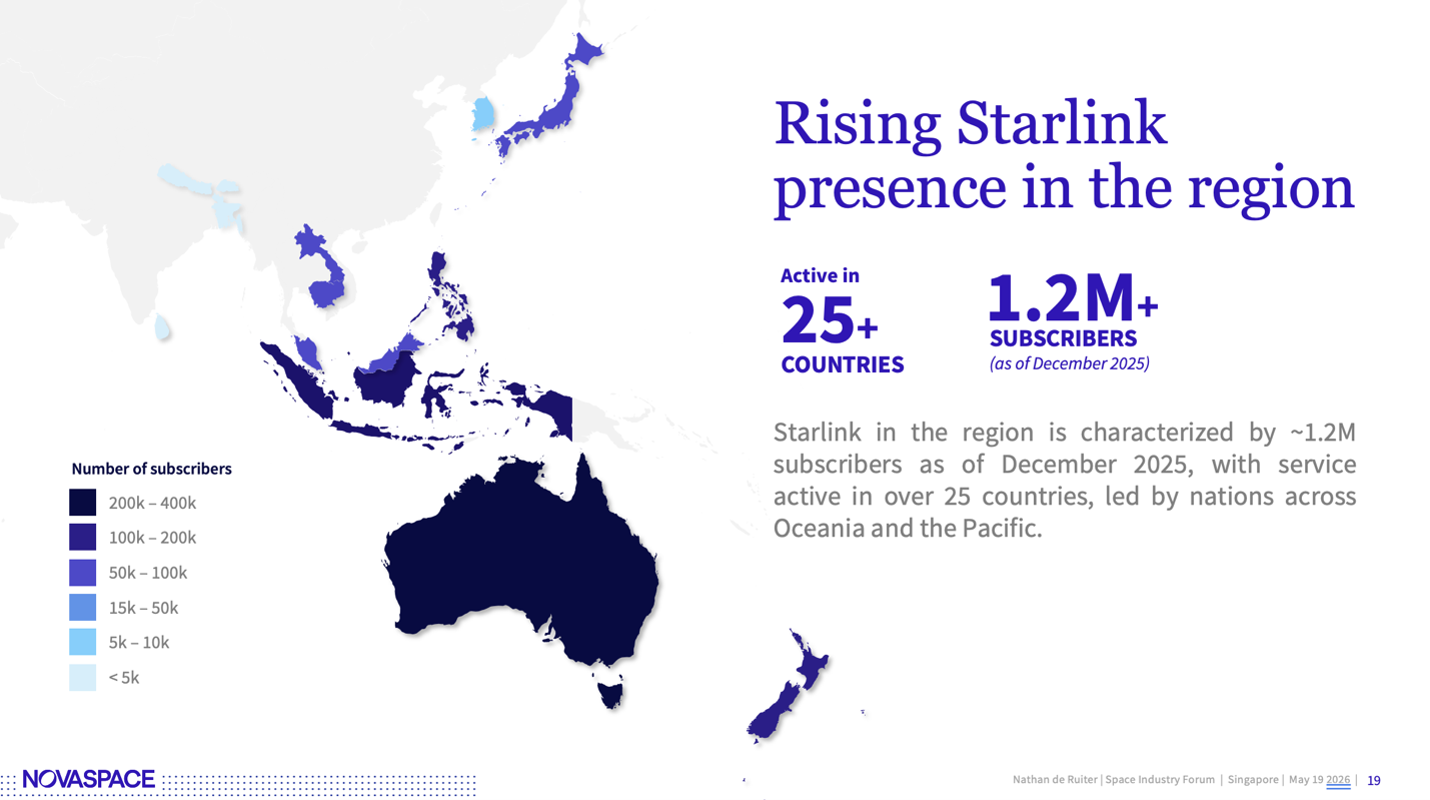 market, causing significant challenges for local operators, and causing difficult decisions for policymakers. On the one hand, Starlink offers relatively low service costs, low latency, and perhaps most importantly in the Indonesian context, small and simple-to-install ground equipment that can easily be shipped to even the most remote areas of the country. On the other hand, there are now multiple large GEO-HTS operated by local operators that can support tens of thousands of sites around the country, albeit with ground equipment that can be more difficult to transport and install. Local operators, for their part, are trying to address these issues, with PSN for example developing their own antenna that they say simplifies installation, but the challenge remains for Indonesia’s regulators: longer-term sovereignty, or immediate convenience?
Indonesia’s push for sovereignty is by no means limited to universal connectivity. During the conference, we heard rumblings of sovereign defense satcom projects, sovereign LOw Earth Orbit (LEO) constellations, and satellite manufacturing planned for Indonesia. Overarching all of these themes was the broader shift from communications towards defense, catalyzed by the 2024 election of President Prabowo Subianto, a former General. Combined with a more uncertain global geopolitical environment, this shift has seen the Ministry of Defense become arguably the country’s most powerful ministry.
Our conversations in Indonesia revealed one more important trend: neutrality. Indonesia, being a large country with nearly 300 million people, is pursuing a strategy of not relying on any one country or group of countries. The conference had participants from the United States, Europe, China, India, and Russia, all trying to sell into this massive market. And Indonesia, for its part, is buying from a variety of sources. All of these trends point towards a central question: efficiency vs. sovereignty. If a country buys all its technology from a single source, even if it internalizes that technology, is it really sovereign? Arguably not. But, if a country buys various systems from many countries, can it really be done efficiently? Time will tell how Indonesia tackles this challenge, but for now, it represents opportunities for a variety of players worldwide.
A Market Lesson in Singapore
After a much-needed weekend in Lombok (which included many BAKTI satellite dish sightings in remote schools), I headed to Singapore for Asia Tech X Singapore, as well as the Satellite Industry Forum (SIF), hosted by Novaspace and the Global Satellite Operator Association (GSOA). Admittedly my time on the ground in Singapore was too short (around 48 hours) to get much of a vibe, however my time spent at SIF was informative of some of the broader regional trends, outlined succinctly and with the usual excellent storytelling my by colleague Nathan de Ruiter from Novaspace.
Nathan laid out the challenge very clearly: Starlink has a rising presence in Asia-Pacific, with market access in more than 25 countries and more than 1.2M subscribers in the region as of December 2025. As the slide below shows, countries such as Australia, Indonesia, New Zealand, and the Philippines are becoming hotbeds of Starlink activity, pressuring local satellite operators to pivot their business plan.
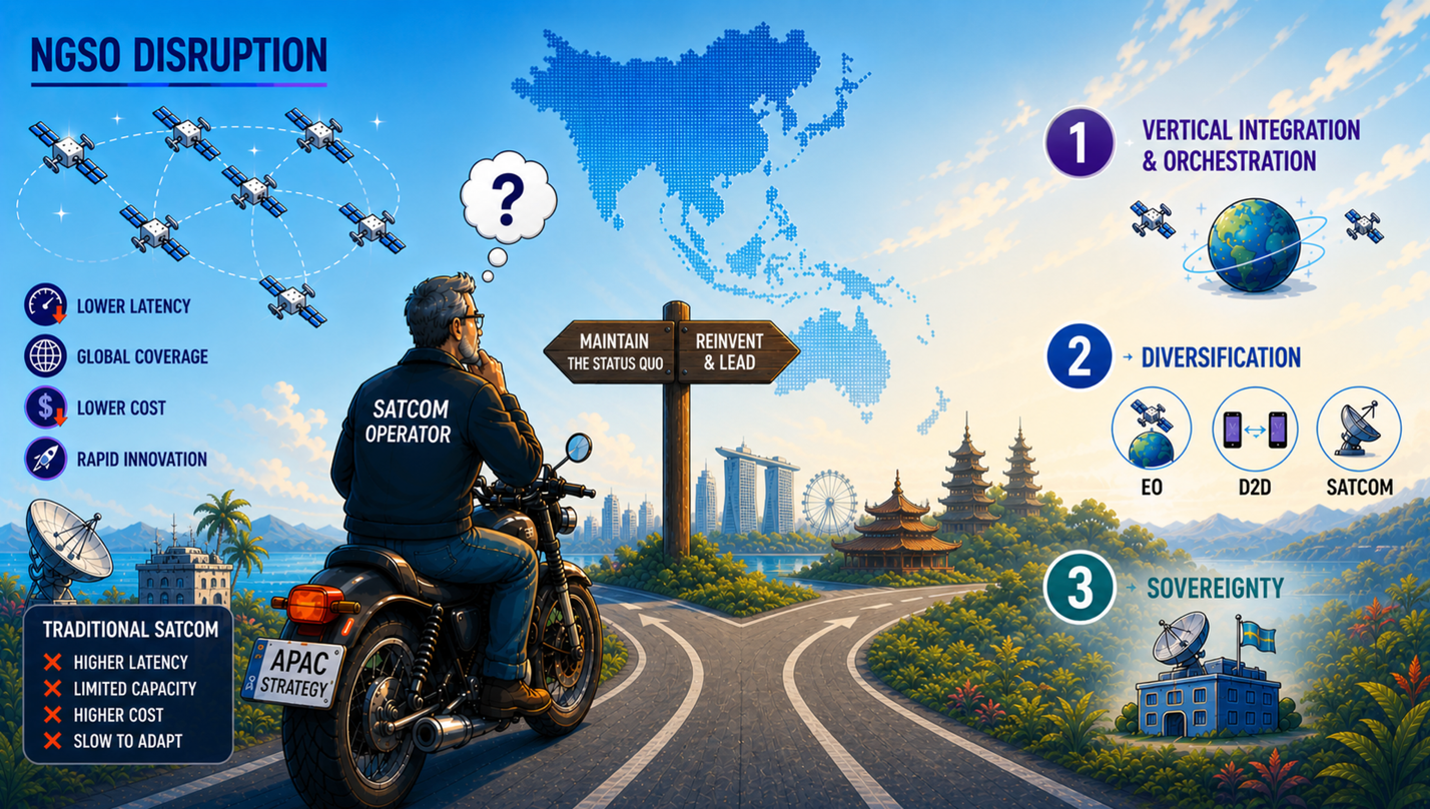
Fortunately, the Novaspace team had some strategies up our sleeve to address this. As per Nathan’s breakdown, as a result of this Non-Geostationary (NGSO) disruption, satellite operators largely have three options:
1) Vertical integration and orchestration, i.e. becoming a “managed service provider” by stitching together multiple Non-Geostationary (NGSO) and GEO offerings and providing turnkey solutions to end customers.
2) Diversified services, expanding offering beyond traditional satcom into Earth Observation (EO), Direct-to-Device (D2D), Positioning, Navigation and Timing (PNT), among others, leveraging space assets to address multiple different pools of demand, i.e. “becoming a space solutions provider.”
3) Sovereign refocus. This is particularly relevant in Asia-Pacific, where several satellite operators are already a de-facto national space company. This strategy involves becoming a “National space champion”, aligning oneself with national objectives and prioritizing ownership, resiliency, and aligning with critical infrastructure.
And so it was at the SIF, with most of the region’s satellite operators and many leading service providers getting together for a day of networking and chewing through some of these ideas. With a variety of upstart satellite manufacturers in the room offering alternatives to Starlink (i.e. Astranis, ReOrbit, K2Space, and more), the tone was clear: it’s an uncertain time with Starlink in our markets, but we are going to band together and we are not going down without a fight.
Rounding Out the Summer Conference Circuit in Daejeon
A few weeks after the conferences in Southeast Asia, the International Space Summit (ISS) took place in Daejeon, South Korea. Hosted by Contec, the ISS brings together an eclectic mix of South Korean and international space companies, and this year’s was the biggest ever, with some 70 exhibitors and more than 1,000 attendees.
 Like APSAT, the ISS showcased different takes on sovereignty. The host country of South Korea is a small, but highly advanced economy with a rapidly-growing space sector. The country’s military and government space projects are extremely ambitious, including the Korea Positioning System (KPS) navigation constellation, multiple defense-related NGSO remote sensing constellations, and several satcom initiatives. Compared to Indonesia, South Korea’s balance of sovereignty vs. foreign players is more nuanced. South Korea is a small country with excellent terrestrial connectivity: the satcom industry is primarily DTH services operated by KTSAT, and while Starlink has entered the market, it poses little threat to Korean satellite operators or telcos.
That being said, South Korea has big space ambitions, and will need to rely on foreign partners for other things, most obviously launch infrastructure. South Korea’s leading commercial launch manufacturer, Innospace, is a case in point, leveraging the Alcantara Spaceport in Brazil for their launch services. Elsewhere at ISS were foreign suppliers of all manner of products including antenna systems, thrusters, ground stations, and more.
One of the highlights of the ISS was continued discussion around sovereign LEO in the Korean (and East Asian) context. Newly-appointed KTSAT CEO Kevin Choi highlighted early-stage plans for a possible sovereign LEO constellation during his presentation, encouraging other Asia-Pacific countries to band together and launch an alternative to Starlink, Amazon LEO, OneWeb, etc. The size of these constellations, costing billions, if not tens of billions of dollars, and being by definition global, is such that even a highly developed country like South Korea (or Japan) cannot justify their own large constellation projects, meaning that they must collaborate, or risk becoming reliant on Starlink and others.
Conclusion: The Future of Space Sovereignty in APAC
The global space sector is becoming more fragmented as more countries pursue their own sovereign space policies, and nowhere is this more apparent than Asia-Pacific. Being home to several of the world’s most prominent Middle Powers, and several leading satcom nations, the region has seen a proliferation of sovereign space capabilities, and the trend is only just beginning.
Moving forward, we should expect several key trends from the region:
1) Proliferation of nation-level remote sensing constellations. This is already occurring in South Korea, Japan, and elsewhere, and more countries are likely to jump on the bandwagon as remote sensing satellites become cheaper and more accessible.
2) Small GEOs for countries, and may even eventually for companies. While Starlink remains the biggest player in the satcom market, the price of small GEOs is becoming more competitive, and data sovereignty becoming more paramount. Already we have seen satellite operators in South Korea, the Philippines, and Thailand purchase small GEOs, and with more options coming to market, this should increase. Eventually, we may even see very large companies (such as state-owned oil & gas companies) start to buy small GEOs for their own internal networks.
3) A pan-Asian NGSO constellation to rival Starlink, Amazon LEO, OneWeb, and Chinese competitors. This will require significant coordination, investment, and cooperation, but will become more likely if, for example, Starlink starts to threaten a greater portion of telco business models.
As always, only time will tell which of these trends takes shape, but in the meantime, it surely is a dynamic and fascinating time to be covering the space sector in Asia-Pacific.
-----------------------
Blaine Curcio is the Founder of Orbital Gateway Consulting. He’s an expert on the commercial space and satellite industries with a focus on the Asia-Pacific region. He can be reached at: blaine@orbitalgatewayconsulting.com