



by Dr. Georg Heinecke
The space industry is at an inflection point. Next-generation non-geostationary orbit (NGSO) constellations demand production volumes that were unimaginable a decade ago. More than 43,000 satellites are expected to be launched between 2025 and 2034.[1] Sovereignty considerations as well as high-profile commercial successes have led to a global funding spree to build space infrastructure on an unprecedented scale. This development has made “industrialization” the talk of the industry with companies announcing factories for series production boasting rates of a few units per month, week or even day.
However, Contrary to the marketing announcements, our experience shows that very few space companies can rightfully claim series production capability today because industrial machines that deliver on time and cost cannot be created overnight and rely not only on one company getting their homework done. Current production systems and organization are still build around customized, low-volume production, with a strong emphasis on engineering expertise. This is the industry's unresolved equation: technological strength without scalable industrial capability. Or as one industry leader put it to us: “Virtually everything in the world is built on assembly lines – except for satellites. Why?”
The Global Scale Challenge
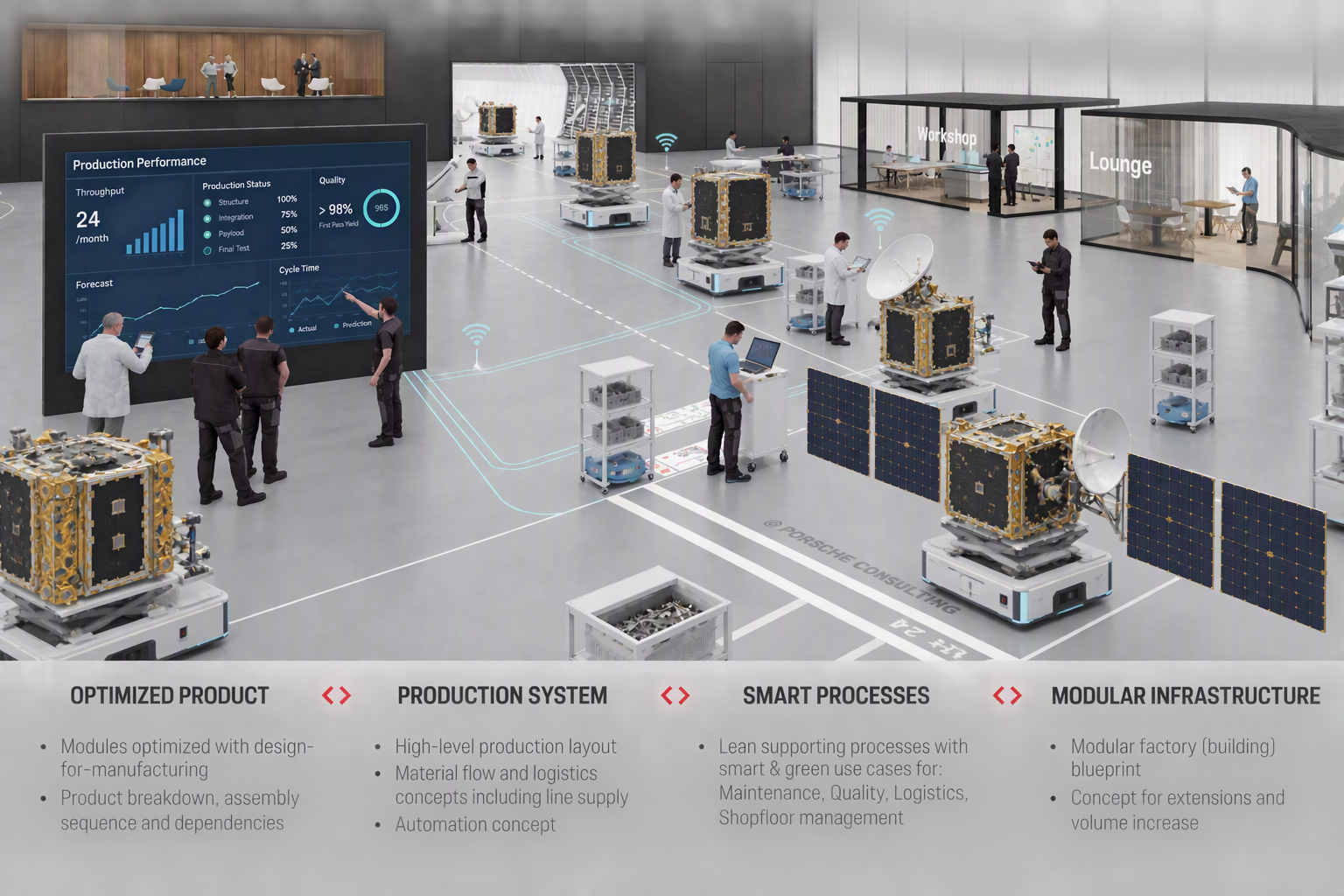
Traditional satellite manufacturing involves complex organizational structures that are dominated by engineers, endless requirements and review iterations, and low volume production and supply systems build around one-off requests. These workshop systems by default optimize towards perfect technical solutions and quality but jeopardize time and cost milestones in the process – one of the reasons why the industry is notorious for its cost and schedule overruns.
A look around the industry is instructive. Launchers, small and large, come to market much later than promised or struggle to increase rates as planned. For instance, launchers could sell many more rides since the Falcon 9 anxiety grabbed the industry but the associated production systems just cannot easily ramp up – even with several years of planning horizons. A similar story unfolds around constellation manufacturing. Scaling production systems remains a central challenge.
Europe as a Case in Point
This situation is particularly evident in Europe. The continent has world-class R&D but struggles to transition into scalable, competitive industrial production. Europe’s space-industrial complex is now finally moving toward stronger sovereign capabilities and greater production scale, but largely through national rather than truly European industrial strategies. For instance, Germany unveiled the most ambitious, defense-driven space policy that places established primes firmly in the drivers seat, making it difficult for its vibrant new space ecosystem to participate. Sovereignty fosters fragmentation: it preserves national capabilities and political support, but also duplicates capacity, limits consolidation, and makes Europe-wide scale and standardization harder to achieve. IRIS² is another case in point. Calls for replicating the tranche-based tender that the SDA applies in the US are falling on deaf ears in the EU. Although this approach has the disadvantage of splitting volumes between several primes, it is an excellent way to spread execution risk: If one company fails to build the industrial machine to deliver on time and cost there are alternative suppliers ready to cover the gap.
Learning from High-Volume Industries
The automotive industry faced a similar transformation a century ago. What was once a craft industry built around bespoke engineering became the world's most sophisticated manufacturing ecosystem. The principles that enabled that shift – Platformization, standardization, modular architectures, and supply chain orchestration – are directly applicable to space.
Beyond Gravity shows how quickly this transition can happen. Working with Porsche Consulting, they introduced flow production at its U.S. facility, making payload production ready for series manufacturing. Production was restructured and scaled from just a few units per year to two units per month. Each process becomes a repeatable sequence, distributed across balanced workstations and supported by closely aligned support functions[2].
Process First, Then Production Line
Herein lies a critical lesson for the space industry: define the process before designing the production line. Too often, companies invest in facility, equipment or tooling before they have fully understood and standardized the manufacturing process. You cannot design an efficient production line without knowing the sequence of operations, the standard work content, the material flow, and the quality control points. You cannot determine floor space requirements without understanding process flow and throughput. You cannot specify workstations without defining the tasks to be performed at each station. The space industry's instinct is often to build the factory first and figure out the process later. This approach guarantees cost overruns, underutilized capacity, and production bottlenecks.
The Hybrid Model
A complete shift to product-based industrialization remains only partially realistic in the space sector. Customer-specific programs will continue to exist, particularly for institutional and scientific missions. The realistic target state is therefore a hybrid approach: platform strategies embedded within programs that remain customer-specific. This requires managing customer-specific programs and standardized platforms in parallel. Companies need modular product and process architectures as well as end-to-end digital value chains – from PLM and ERP through MES. The goal is not a "mass-produced product" but industrialization in a complex environment.
The Path Forward
To meet the demand of the NGSO era, the space industry must move from bespoke to batch. This requires: Platformization through modular architectures that enable standardization without sacrificing mission flexibility; industrial operating models with end-to-end digital value chains connecting engineering, manufacturing, and supply chain. Partner governance ensures that prime contractors and suppliers scale together as one production system. Most critically, it requires a fundamental shift in mindset: define the process before you design the production line. Build the factory around the process, not the other way around.
The transformation must be delivered at speed, built with resilience, and designed to strengthen technological independence. Porsche Consulting supports space companies in this transition, from industrial operating models and platform strategies to scalable production and partner networks.
[1] Novaspace: Satellites to be Built and Launched (2025)
------------------------------

Dr. Georg Heinecke is Associate Partner for the space industry at Porsche Consulting, where he advises established space companies and New Space ventures on strategy, industrialisation, and business growth. With more than a decade of experience in the space sector, he has worked across the full space value chain, from manufacturing and operations to downstream services. He holds a PhD from ETH Zurich and is co-author of the Porsche Consulting white paper The Race to Space.He can be reached at: georg.heinecke@porsche-consulting.com