



It was business as usual at CommunicAsia 2009 as 54,354 attendees congregated at Asia’s largest media and IT trade event from June 16-19. Of the total number of attendees, 49 per cent came from outside of Singapore, hailing from about 100 countries across Asia-Pacific, Europe, US and the Middle-East.
It was business as usual at CommunicAsia 2009 as 54,354 attendees congregated at Asia’s largest media and IT trade event from June 16-19. Of the total number of attendees, 49 per cent came from outside of Singapore, hailing from about 100 countries across Asia-Pacific, Europe, US and the Middle-East.
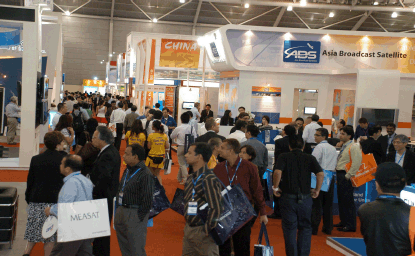 Spanning 58,000 square meters in six sprawling halls , the exhibitions featured 1,923 exhibiting companies from 60 countries and regions. The shows saw a total of 34 group pavilions, with countries like Belgium, Brunei Darussalam and Vietnam participating for the very first time.
The announcement of two Asia-Pacific Direct-to-Home (DTH) platforms (Echostar/AsiaSat for Taiwan and VTV/Canal+ for Vietnam), along with a new Asian procurement and launch programs for Intelsat and Asia Broadcast Satellite (ABS), plus an Arianespace launch contract for Singapore/Taiwan’s ST-2 satellite, demonstrated the health and viability of the Asian satellite market.
During the CASBAA Satellite Industry Forum held the day before CommunicAsia, CASBAA and Euroconsult announced 9% regional market growth for 2008 (according to the CASBAA’s "Video in Demand" Asian satellite services report), the highest recorded in the past decade. According to CASBAA, another six Asia- Pacific satellites are set to be launched in the next six months. "Satellite services are central to the good health of Asia’s domestic and regional communications industries," said Simon Twiston Davies, CEO of CASBAA.
Keynoted by Houlin Zhao, Deputy Secretary-General of the International Telecommunications Union (ITU); Romain Bausch, CEO & President of SES S.A. in Europe; Huang Baozhong, VP of China Direct Broadcast Satellite (China DBSat) and Mark Dankberg, Chairman & CEO of Viasat in the US, the CASBAA gathering of global executives was determinedly upbeat as it addressed the most urgent issues facing the worldwide satellite sector.
In his opening remarks, Houlin Zhao of the ITU highlighted the thorny issue of orbital slot co-ordination and satellite signal interference generated by WiMax deployments by 3.5GHz wireless ground systems.
According to Zhao, the ITU has urged "Industry and governments alike to work more closely with the ITU to help resolve the current issues of overcrowding, increasingly lengthy delays imposed by unwieldy co-ordination requirements, and the chronic problem of ‘paper satellites’" – fictitious frequency assignments recorded in the Master International Frequency Register. Zhao later announced that the ITU World Radiocommunication Conference (WRC-11) had been unexpectedly delayed from late 2011 until 2012 in Geneva.
In other sessions, Huang Baozhong of China DBSat noted that Push Video on Demand is China’s latest strategy to increase access to digital content and is preparing for the launch of a new DTH service that could, according to analysts, revolutionize China’s broadcast market.
The health of satellite communications in the face of a global recession remains robust, but it cannot afford to become complacent, according to Romain Bausch of SES S.A.. The satellite industry is not necessarily an "island of prosperity in turbulent seas", he said.
Meanwhile, Rudy Tanoe, President Director & CEO of Indovision (operating a DTH platform from the newly deployed S-band payload on the Indostar-2/Protostar-2 satellite), commented that Indonesia should have more than one million DTH subscribers in the next 12 -14 months. Nevertheless, the potentially catastrophic problem of pay-TV piracy remains to be addressed.
On the other hand, Vikram Kaushik, MD & CEO of TataSky in India, noted that DTH services could reach 50 million Indian subscribers by 2015 – if satellite capacity is made available. Regulatory constraints remain an issue in many satellite markets, according to several speakers at the CASBAA Satellite Industry Forum as well as the CommunicAsia Satellite Summit.
"While this is a challenging economic time, the resilience of the satellite sector and the demand for satellite services is testament to the critical nature of satellites for the distribution of television programming and for enterprise connectivity around the globe," said David Ball, Regional Vice President Asia-Pacific for Intelsat and Chairman of the CASBAA Satellite Industry Committee.