



The CABSAT & Satellite Middle East/North Africa (MENA) 2011 show held in Dubai, UAE, from February 8-10 bills itself as the third-largest satellite event of its kind in the world and it has grown by 15% compared to last year. More than 750 companies from 55 countries, including 11 national pavilions, exhibited at the Dubai World Trade Center showcasing the latest products and developments in the broadcast, digital media and satellite markets.
“This presages a quantum leap in the digital media and broadcast industry in the region,” said Sheikh Hasher bin Maktoum Al Maktoum, director-general of Dubai’s Department of Information, who officially opened the show.
With the TV audience in the Middle East projected to rise by almost 20% over the next three years and 19 new satellites scheduled for launch by 2013, according to research firm EuroConsult, opportunities are rife for satellite service providers in the sprawling MENA region straddling three continents of Asia, Africa and Europe with an affluent, upwardly mobile population of over 500 million.
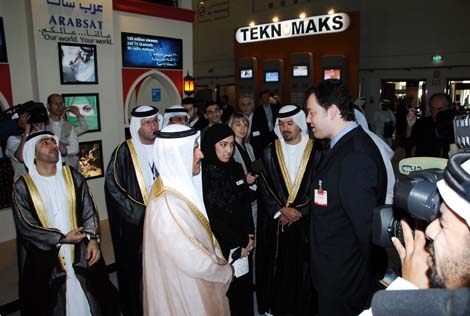 The geography and population dispersion in the Middle East Ka-band poised to become major market in the MENA region seems tailor-made for satellite communication solutions. The population is concentrated in cities separated by vast stretches of desert. While some efforts have been put forth by various national governments to invest in fiber optics, cost and logistics limit the fiber networks to the most important and largest centers.
Climate, geography, population distribution and culture combine to create the robust demand for satellite capacity, ground equipment and services in the MENA market. Satellite broadband Internet is gaining ground while backhauling for commercial cellular phones and enterprise networks maintain a respectable pace behind. The majority of satellite TV in the region, roughly 75%, is offered free to air (FTA) with revenue generated through advertising, or subsidized for some other purpose such as education.
The preponderance of FTA satellite is a unique feature of the MENA region. Not even the introduction of premium services such as HD and 3D TV can reverse the trend for audiences in the Middle East to prefer free satellite channels. However, like terrestrial TV, FTA channels in the MENA region are enjoying brisk business from sponsorships and ad revenue.
I was privileged to have chaired a session at the GVF MENASAT Summit themed, “New Drivers, New Dynamics: MENA Communications Markets, Applications & Technologies.” The summit is part of the CABSAT & Satellite MENA 2011 exhibition’s “Knowledge Exchange and CABSAT Academy” program.
The 2011 MENASAT Summit takes place at a time when, according to research and consulting firm NSR estimates, the Middle East/African market generated US$1.35 billion in capacity-leasing revenues for FSS operators last year, a figure expected to grow by 3%-4% in the region for the coming year driven by a mix of applications, ranging from video distribution to DTH and data services. Within the broadband satellite markets in the Middle East and Africa, NSR further estimates that trunking and backhaul services accounted for about three-quarters of the over 280 transponder equivalents (TPEs) of leased C- and Ku-band capacity in 2010.
In the summit keynotes, Fatem Bader of the Arab Advisors Group and Claude Rosseau of NSR cited that monopolies are on the wane in the region, with more competition being introduced in the media sectors. This bodes well for commercial service providers who are coming to the MENA region in droves.
The highlight of the satellite summit is the session on “The Future is Ka,” featuring Jean-Pierre De Muyt, vice-president of Worldwide Sales for Newtec; Christian Patouraux, chief product development officer of O3b Networks; Dr Muhaned Juwad, consultant at Avanti Communications; and Matteo Altobelli, marketing director of Eutelsat. The speakers took turns in extolling the virtues of Ka-band and outlined plans to launch Ka-band satellites and services in the region.
No doubt buoyed by the success of Ka-band satellites in North America which reached the one-million subscriber mark in record time, more Ka-band satellites have been launched or will be launched in the MENA region than in any other region in the world.
London-based Avanti Communications last year launched its Hylas 1 satellite, which partly serves the region, and is planning to launch another satellite this year. Last December, Eutelsat launched its all-Ka-band satellite Ka-Sat, while O3b (which stands for the “The Other 3 Billion” without broadband access), UAE-based Al Yahsat and regional operator Arabsat have announced plans to launch Ka-band satellites providing services across the MENA region and beyond .
Ka-band, which has been traditionally viewed as ideal for broadband applications due to its higher bandwidth and speed of up to 10 times the current services from Ku-band, can also be used for many other applications in the maritime, oil and gas industry, GSM backhaul, voice and IP trunking and VSATs, among others — markets that are in great demand in the MENA region.
Globally, the projected Ka-band bandwidth to be added in the coming years by new satellites is expected to be between 300 Gbps and 400 Gbps more than the total bandwidth avail-able today from C- and Ku-band satellites combined, according to Newtec’s De Muyt. Aside from the larger throughputs and faster speeds, Ka-band would be several times cheaper per MB than C- or Ku-band. This will definitely hasten the diffusion of broadband services in the region, which is now growing at an exponential pace. And unlike FTA satellite channels, broadband is something that users in the MENA region are willing to pay for.
------------------------------
 Virgil Labrador is the Editor-in-Chief of Satellite Market and Research based in Los Angeles, California. He is the author of two books on the satellite industry and has been coering the industry for various publications since 1998. Before that he worked in various capacities in the industry, including a stint as marketing director for the Asia Broadcast Center, a full-service teleport based in Singapore. He can be reached atvirgil@satellitemarkets.com