

by Markus Fritz
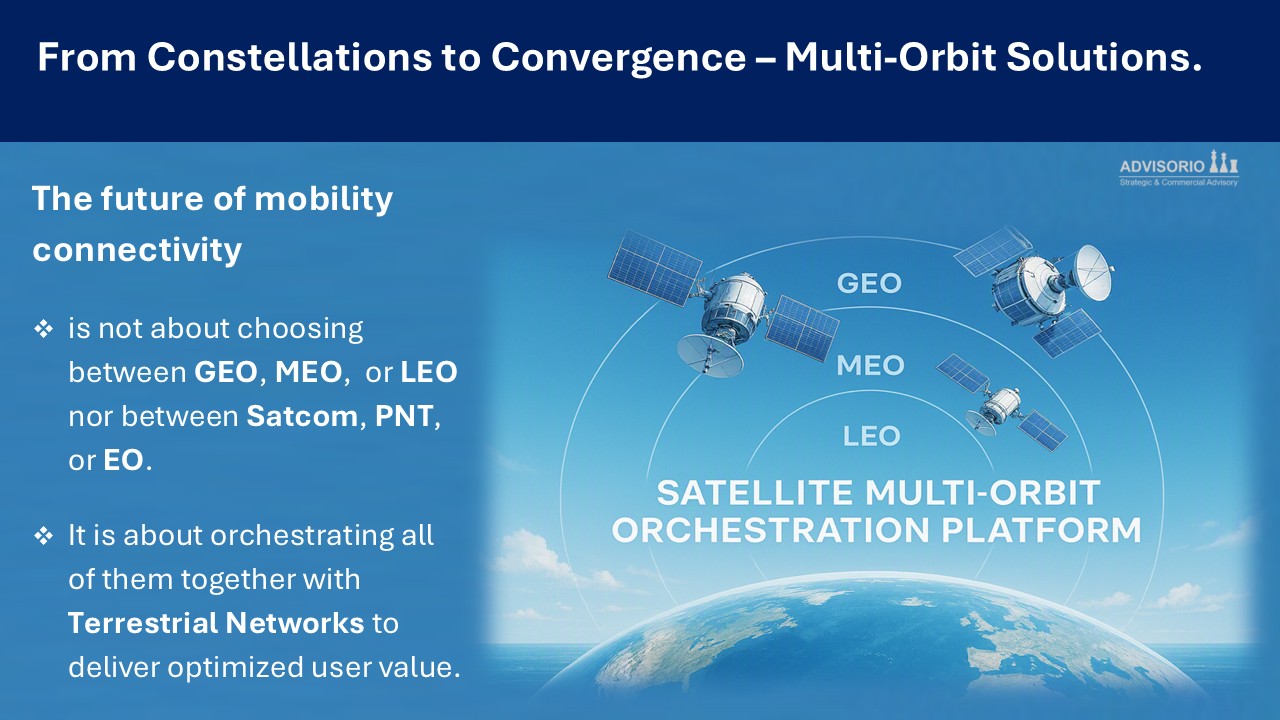
Luxembourg City, September 4, 2026--The satellite industry has proven it can deliver connectivity almost anywhere on Earth. Ubiquitous coverage is no longer a differentiator; it is the baseline. For the next generation of smart mobility autonomous vehicles, precision agriculture, connected rail, advanced air mobility and defense - true value lies in intelligently orchestrating multi-orbit assets and multi-domain space capabilities, seamlessly integrated with terrestrial networks. The era of convergence has begun, where Satcom, Positioning, Navigation and Timing (PNT), Earth Observation (EO) are fused into single, actionable streams.
 The Demand Side: “Multi-Domain Orchestration in Action”
The "why" is driven by a powerful combination of consumer demand, safety regulation, and strategic end-users - no longer buying bandwidth or pixels; they buy outcomes. Smart farming offers a compelling blueprint. Telespazio, through its e-GEOS digital platform, is delivering multi-space domain orchestration for agriculture, fusing EO imagery for crop health, Global Navigation Satelltie System (GNSS) and emerging Low Earth Orbit-Point, Navigation and Timing (LEO-PNT) signals for autonomous tractors, Satcom for real-time telemetry in rural areas, and weather forecasts. John Deere builds satellite data directly into their precision-farming operations center.
In autonomous vehicles, the demand for orchestration is even more pronounced. Terrestrial to Non-Terrestrial Network (NTN) integration means a car must hand over seamlessly from 5G roadside units 5G NTN, while simultaneously ingesting GNSS corrections from Galileo or Xona’s LEO PNT service for lane-level positioning, and receiving road hazard alerts derived from thermal EO or Synthetic Aperture Radar (SAR) imagery. A single satcom pipe or a standalone Global Positioning System (GPS) receiver can no longer meet the emerging requirements for autonomous vehicles; only a converged multi-domain stream can.
Smart transportation and rail follow the same logic. Real-time tracking across continental routes demands continuous multi-orbit connectivity, while EO monitors infrastructure deformation and vegetation encroachment. PNT ensures positive train control where terrestrial networks fail. Smart aero from aircraft to Electric Vertical Take Off and Landing (eVTOL) and drones requires seamless connectivity, EO for volcanic ash and severe weather avoidance, and resilient 3-dimensional PNT. Maritime and shipping increasingly rely on orchestrated platforms that combine multi-orbit satcom for crew welfare and IoT, SAR and optical EO for ice monitoring and piracy detection, and optimized weather routing.
Emergency services need instant situational awareness post-disaster. An orchestrated platform delivers pre- and post-event EO and SAR, resilient PNT for search teams, and on-the-move satcom via GEO/LEO, all fused into a common operating picture. Military and Defense - takes this to the extreme. “Space-supported 360° situational awareness” describes a battle management ecosystem, where multiple satellites feed a unified threat and environment map, enabling agile action. The ICEYE Rheinmetall orchestration platform, is a prime example. It integrates ICEYE’s own SAR satellites with thermal infrared data from OroraTech, hyperspectral monitoring from Constellr, and rapid satellite manufacturing from Reflex Aerospace, offering Defence customers a single, multi-sensor space intelligence solution.
The Supply Side: “Satellite Operators Build the Orchestration Layer”
Satellite operators are retooling their strategies from connectivity providers to orchestration platform owners. The clearest manifestation is the wave of multi-orbit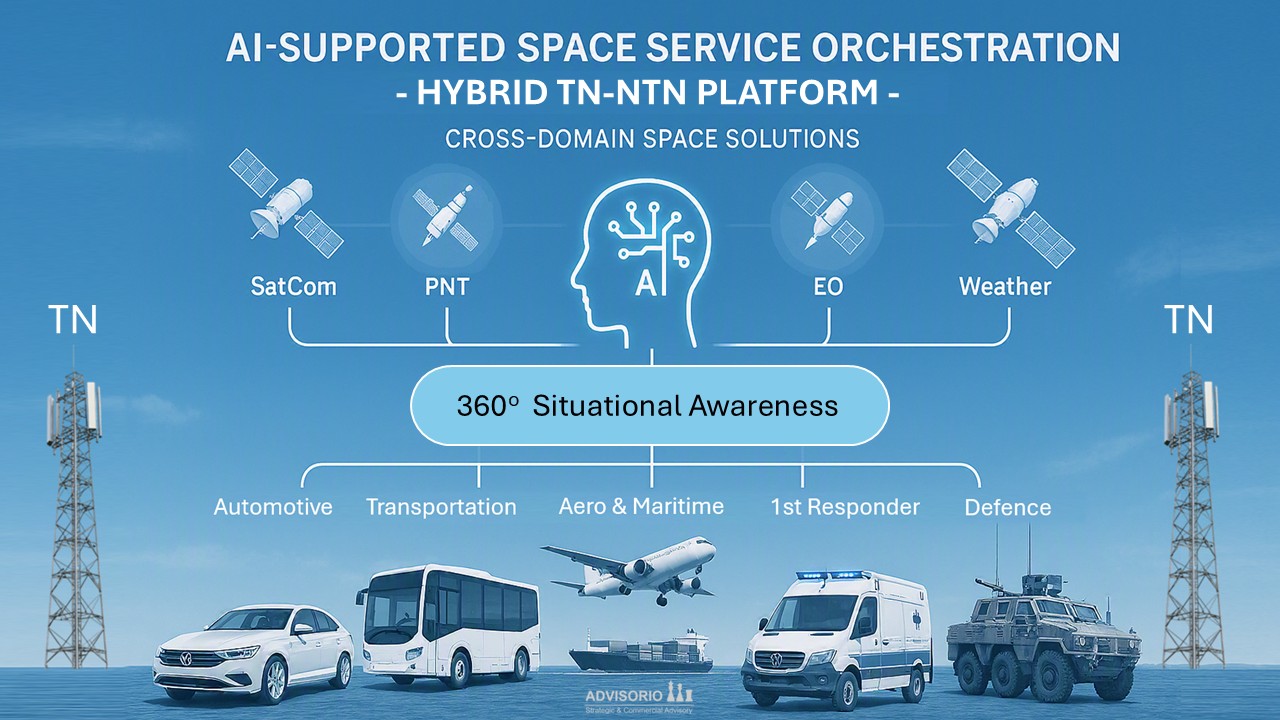 consolidation and partnership.
Eutelsat OneWeb combines GEO and LEO connectivity under one roof, targeting mobility segments. SES and Intelsat are pursuing multi-orbit GEO/MEO architectures, while co-investing in LEO ventures such as Lynk, Omnispace and OQ Technology to extend into direct-to-device and Internet of Things (IoT). The planned combination would create an unparalleled multi-orbit fleet, enabling dynamic service orchestration across orbits. Viasat, following the Inmarsat acquisition, now orchestrates Ka and L band capacity across GEO and LEO through partnerships, while its recent agreement with Space42 (branded as Equatis), aims for seamless, multi-orbit, multi-waveform mobility services.
SpaceX is a special case. Starlink already provides low-latency global connectivity and is actively exploring a secondary, triangular PNT capability from its LEO constellation, complementing traditional GNSS. Its Starshield programme extends the platform to include SAR and EO, creating a vertically integrated multi-domain offering for government and Defense.
On the dual-play EO and data side, orchestration is equally vibrant. Open Cosmos offers “Open Constellation,” an end to end infrastructure that lets customers launch and manage multi-sensor EO missions, and has recently introduced “Connected Cosmos,” which aims to provide seamless Ka band connectivity, integrating communications directly into its data orchestration platform. ICEYE’s federated constellation model allows partner nations to own co-located SAR satellites, contributing data to a shared orchestration pool.
Meanwhile, LEO-PNT is emerging as a critical orchestration domain. Beyond Galileo’s authenticated positioning, dedicated LEO PNT constellations are being built. Thales Alenia Space and OHB/GMV are both developing LEO PNT demonstrators for ESA, while GMV’s high accuracy PNT correction data service also delivers the integrity and centimeter level precision required for autonomous mobility. These services can be integrated alongside Satcom links and EO data in the unified control interfaces that Tier 1 automotive suppliers and Defense integrators are beginning to demand.
Underpinning much of this activity, Europe’s industrial champions are placing orchestration at the heart of their space strategies. SES, Eutelsat and Hispasat are building multi-orbit constellation offerings. Airbus is advancing multi-orbit terminal technologies. The LEO NMS web-based multi-user tool of Integrasys facilitates seamless orchestration and management of LEO, MEO, and GEO constellations. The European Space Agency’s Bridging Across Space-based Systems (BASS) team acts as a critical integrating force in this domain, bringing together the Satcom, PNT and EO communities to develop cross-domain use cases make cross-domain orchestrated space solutions a reality.
The Convergence Imperative
The satellite industry is transitioning from selling pipes and pictures to selling integrated outcomes. This demands business-model innovation, joint standards, open APIs, and cross-domain partnerships as much as it does multi-orbit antenna technology. Operators that simply add more capacity will struggle to capture a premium; those that embed their capacity within an intelligently orchestrated multi-domain fabric will own the customer relationship. Leveraging AI to support this orchestration will significantly boost operators’ capabilities, enabling real-time resource allocation, predictive service optimization, and automated cross-domain fusion at scale. To convert ubiquitous coverage into truly transformative smart mobility solutions, the satellite industry must merge multi-orbit and multi-domain assets into seamlessly orchestrated platforms, unlock exponential user value - and drive market penetration far beyond connectivity alone.
------------------------------
Markus Fritz is the Managing Director & Owner of ADVISORIO, a premier consultancy serving global leaders in telecommunications, space, automotive, smart mobility, and ICT. Markus Fritz advises on growth strategy, market development, partnerships, business models, and M&A, guiding corporations, scale-ups, public institutions, and think tanks in commercializing innovation. With 25+ years of executive leadership at SES Astra, Eutelsat, and Arabsat, he directed international commercial strategy, marketing, and strategic partnerships. A former board member of Digital Europe and ZVEI, and SAMENA Council Ambassador, he shaped policy and interoperability and open standards in the ICT industry. He can be reached at: markus.fritz@advisorio.com