


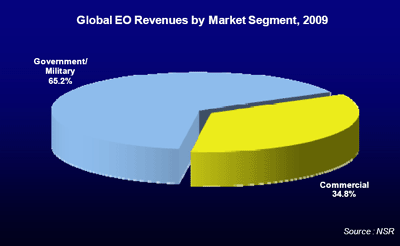
There has been solid growth in the Earth Observation (EO) market in the past few years due to a strengthening of demand for civil government and military EO satellites and associated data. However, this reliance on government and military organizations distorts true market economics, as only a few large users such as the National Geospatial Intelligence Agency (NGA) provide the majority of revenues for U.S.-based operators according to NSR.
Governments have been and continue to be the main funding sources for spacecraft and imagery in the EO market; more than 60% of the EO satellites launched today or in-orbit are operated by or are for government entities. NSR forecasts also that 77% of all new satellites in the coming ten years will be owned or operated by a government or military client, thus the pace of change towards commercial use and financing for EO is expected to continue to be slow.
In the last few months, there has been a flurry of activities for both military and civil government satellites programs. In November 2010, the € 1.1 billion ($1.4 billion) Italian Cosmo-SkyMed military surveillance system was completed with the fourth satellite launched. The whole constellation will now be able to transmit a staggering 1,800 synthetic aperture radar (SAR) pictures a day. Later in December 2010, France’ Direction Générale de l’Armement (DGA) ordered two next-generation Helios optical satellite from Astrium with an option for a third satellite at a total cost of € 795 million ($1.05 billion).
 These two systems will be even more powerful than their ancestors, and their sophistication level will noticeably increase. With much higher revisit time, systems such as COSMO-Skymed, which is government-owned but commercially-operated (by Telespazio), are not only able to provide tactical information but also complement other nation’s current capabilities and open up new markets.
Besides the large contract for data distribution awarded to private firms by the U.S. Government in December 2009, it is true that data from these and other military EO and surveillance satellites could be useful for many other governments around the world. Discussions are reported to be in advanced stages with Turkey (which also has the Gokturk optical satellite), Japan (which has a 2013 launch date for its next SAR mission), and Australia (whose government recommended having a space-based radar satellite in the coming years).
What this does, especially when governments act as suppliers, is skew the economics of the EO market as comparable products are offered at very low prices, since governments only need to recover the cost of manpower (sometimes not at all) and do not have the amortization of the satellite and associated ground segment to repay as would the private sector.
Government satellites do not have to be economically viable, and the data policies are not always market compatible. ALOS (JAXA) data is sold at a very low price by Japan, and Brazil’s space agency INPE now gives away CBERS satellite data for free. In Europe, the European Parliament adopted a policy for the Sentinel satellites to be launched in a few years whereby data will be distributed for free. And to make it more open, participating missions to the GMES program (of which Sentinel is the first element) will also have the obligation to give part of their data freely. This is a strong competition element for any commercial imagery supplier in the same market segments.
What is the private sector to do in these circumstances and under this heavily-slanted market environment? Growing its government business on both supply (satellites) and demand sides (data and value-added services) would seem to be the logical answer. Very few actors in the sector can afford to build satellites on their own (unless they are small and cheap) or make a business with commercial customers only. The notable exception in this may be Astrium Services’ GEO Information Services whose parent company, EADS, has a €10 billion treasure chest that it will use to build the Spot-6 and -7 satellites. Is this exception an emerging trend or a noticeable blip on the radar screen?
The Bottom Line
NSR believes that the Astrium example is something to follow in the long-term. The history of the Spot program has unfolded the way many in Europe think is the right direction for the EO market: a lot of initial funding from government to an eventual spin-off to commercial funding and user development to accelerate the maturity of the market. In the meantime, the tilted economics of EO will see billions of dollars more pumped into new and more capable satellites that will relentlessly but slowly extend the breadth and depth of the EO market.
Information for this article was extracted from NSR's report Global Satellite-Based Earth Observation, 2nd Edition.