



by Elisabeth Tweedie
Los Angeles, Calif., March 6, 2026 --Many years ago, video distribution was a relatively straight forward operation. Video went from the camera, to the studio for immediate or delayed linear broadcast transmission. Non-live programs would probably incur some editing and packaging prior to transmission.
Things haven’t been that simple for many years. Video distribution is now a multi-faceted process, involving many layers of technical and business complexity. Content owners are faced with a fragmented infrastructure and many diverse options when it comes to monetizing that content.
A Distribution Ecosystem in Overdrive
Video contribution may arrive from multiple sources, and be distributed in multiple formats at varying times. It may be a linear or on-demand transmission. It may be transported over the air terrestrially, or by satellite or may be streamed over-the-top (OTT), and it may be viewed on multiple devices; TVs, laptops, tablets or mobile phones, all of which require different formatting. Advertisements, which will vary by region and even by individual may be inserted.
But the complexity doesn’t end there. There is no such thing as a “one size fits all.” Localization is a given. Linear programming needs scheduling for different channels and time zones and the electronic program guides (EPG) need to be created in multi-languages for multiple platforms. For OTT distribution, adaptive bit rates are needed to accommodate different internet speeds and device capabilities. When content is distributed to different countries, subtitling in multiple languages may be needed. Compliance with local copyright laws, licensing agreements and content restrictions is essential.
Monetization: The Strategic Imperative
However, the physical distribution to the viewer is only one piece of the equation. Once there, the quality needs to be monitored, so return feeds need to be established with service level agreement-(SLA) based alerts and automatic fault detection. Most importantly, the content owner needs to be able to monetize the content. This could be through subscription services, but now it is increasingly likely to be through the insertion of advertisements.
Subscription Video-on-Demand (SVOD) remains dominant, but growth is shifting. Advertising-supported Video-on-Demand (AVOD) is expanding at nearly double the rate of SVOD. Free Ad-Supported Streaming TV (FAST) is projected to grow even faster through 2030. Although total revenue from Advertising supported Video-on-Demand (AVOD) is significantly less than revenue from Subscription Video-on-Demand (SVOD), it is growing at nearly twice the rate, (CAGR of 13% vs 7%). Free Advertising supported Streaming TV (FAST) is projected to grow even faster with a global CAGR of 16.5% between 2023-30. Programming may be global, but ad insertion is not, it will almost always be local and in some cases, personal; so tags need to be inserted into a video stream to facilitate this.
A new way of content monetization is through the insertion of QR codes creating a direct interactive experience as viewers are enticed to click through to view more information and even buy the product that is being advertised. Obviously, this interaction needs to be tracked on a per show and/or per campaign basis to measure the effectiveness of this new way of content monetization.
Discoverability: The Hidden Challenge
However, before a content owner can monetize its content, that content needs to be found. This is relatively straightforward with linear distribution where new shows can be advertised as needed. For on-demand content, this is more challenging. Surveys have shown that OTT viewers can spend upwards of 12 minutes searching for content. So the content has to be appropriately tagged and categorized with appropriate keywords across all platforms to facilitate discoverability, Search Engine Optimization (SEO) is as important for video entertainment, as it is for products and services advertising on the web.
Video distribution is complex. There is no one product that handles all of these different options and systems. So, the content owner is faced with “stitching together” products and services to create a distribution system that meets their needs. This means dealing with many different protocols and logins. A time-consuming and challenging task.
iKOSYSTEM: A Unified Approach
One company is out to fix this. iKOSYSTEM, a new service from iKOMG (www.ikomg.com) creates a centralized partner portal for iKOMG customers. It provides a single, secure interface to access, operate and monitor all iKOMG services that a customer has subscribed to. iKOSYSTEM covers the entire ecosystem from playout and monitoring, to EPG creation, broadcast, OTT and FAST distribution, as well as providing viewer engagement tools.
Everything is available and accessible from one dashboard with a single login. A revolution for the industry.
--Adir Hadad, VP-Cloud Services, iKOMG |
iKOSYSTEM brings together eight different elements of the video distribution chain. A customer can access any or all of these depending on their needs, from one simple tiled dashboard, with one operational view and one login. If needs change and additional elements are required, these are simply added to that customer’s dashboard. iKOSYSTEM has eight Integrated Modules:
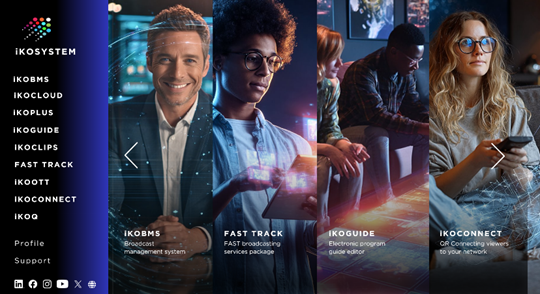 • iKOBMS – Broadcast Management System with centralized scheduling, metadata control, rights-aware automation, and multi-time-zone support.
• iKOCLOUD – Cloud-based playout engine with automated execution, redundancy, and integrated monitoring.
• iKOPLUS – Multi-location return feed monitoring with SLA-based alerts and automated fault detection.
• iKOGUIDE – Multi-language, multi-platform EPG authoring and distribution system.
• iKOCLIPS – Instant live clip generation with metadata tagging and multi-platform distribution.
• iKOFAST – Complete FAST channel automation including EPG synchronization and monetization support.
• iKOOTT – OTT CMS and distribution control supporting AVOD and SVOD monetization and multi-device delivery.
• iKOQ – Dynamic QR engagement engine with campaign-level configuration and analytics.
iKOSYSTEM is a professional-grade control interface designed by engineers for engineers. It supports broadcast, satellite, IP, cloud, OTT, FAST, and hybrid workflows with full audit trails and activity logs.
This unified system is a complete game-changer for content distributors. No more messing around with multiple URLs, different credentials and disconnected tools. The secure web-based service can be accessed from anywhere. Centralized control of complex broadcast workflows leads to fewer handovers and faster operational decision making. The modular nature of the system means that additional iKOMG services can be added instantly, so the system scales to meet client requirements. This is not a marketing gimmick, it was designed by engineers for engineers. It is a professional-grade control interface supporting broadcast, satellite, IP, cloud, OTT and hybrid workflows with full audit trails and activity logs.
The official launch of iKOSYSTEM is March 2026. Adir Hadad, VP Cloud Services, iKOMG, said “iKOSYSTEM was developed after listening to customers’ complaints about how irritating and time consuming it is to deal with multiple systems and logins. Customers in the beta trial really appreciated how iKOSYSTEM streamlined and simplified daily operations. I’m excited to now be able to offer this scalable, modular system to all our customers.”
---------------------------
Elisabeth Tweedie is Associate Editor of the Satellite Executive Briefing has over 20 years experience at the cutting edge of new communications entertainment technologies. She is the founder and President of Definitive Direction (www.definitivedirection.com), a consultancy that focuses on researching and evaluating the long-term potential for new ventures, initiating their development, and identifying and developing appropriate alliances. She can be reached at: etweedie@definitivedirection.com