

by Bruce Elbert
Austin, Tex., March 10, 2026--Technology developers and startup companies abound in the space that we call the space industry. The drive at this moment is to move into the government sphere where there are many new requirements and what appears to be ample budget to reward those entities that have a unique capability to offer in satisfying the evolving missions of defense and security. This is not a new idea and it worked in reverse after previous wars where government contractors sought to transform themselves into commercial product and service producers outside of what was familiar and rewarding to them. Post-WW2 examples include Raytheon and Boeing in the US, Mitsubishi and NEC in Japan, and Messerschmidt and Siemens in Germany. But right now, our industry is disrupted by the huge footprint of LEO satellite constellations and interest in near and deep space missions akin to what was more common in the 1960s and 1970s.
In the last few years, governments have been trending toward more investments in civil and military space-related infrastructure. Many programs and organization changes are publicly known, like the following gathered from an Internet search:
- Golden Dome - a comprehensive missile defense shield using space-based sensors and potential interceptor technology.
- Next-Gen Overhead Persistent Infrared (OPIR): SBIRS was a foundation program going back several decades. With new technology, OPIR focuses on advanced missile warning and tracking, including high-altitude and polar-orbiting satellites.
- The Space Development Agency (SDA) is deploying hundreds of small satellites in low Earth orbit (LEO) for missile tracking (Tracking Layer) and data transport (Transport Layer). Key launches are scheduled for late 2026, although some aspects are recognized to have been pursued aggressively without adequate technology readiness (discussed later).
- Evolved Strategic SATCOM (ESS): A major constellation being developed to replace the Advanced Extremely High Frequency (AEHF) system, providing secure, survivable communications for strategic nuclear command and control.
- Protected Tactical SATCOM (PTS): A program transitioning toward commercial-based designs to provide jam-resistant tactical communications to warfighters.
- Geosynchronous Space Situational Awareness Program (GSSAP): Maneuverable "neighborhood watch" satellites that conduct close-up inspections of other objects in geosynchronous orbit.
- In-Space Servicing & Maneuver (ISAM): Multiple missions are planned for 2026 to demonstrate on-orbit satellite refueling and repair.
- Commercial Augmentation Space Reserve (CASR): Moving to full-scale operations in 2026, this program establishes pre-negotiated contracts to surge commercial satellite capacity during wartime.
These are the big names but you don’t need to garner all or a major section of one of these to profit from government business in space. Still, they point to the climactic change we are experiencing where space is more strategic than it’s every been and that character is not likely to change for a considerable period.
Today we especially have the backdrop of threats worldwide related to cybersecurity, deadly unmanned combatants like drones and robots, and more sophisticated surveillance for government and military applications. There are also challenges from other sectors where companies are scrambling to repurpose or develop new products and services for the gov/mil market. How best can they effect this transition?
To address this question, we need to understand the two sides of this equation – who has what to offer the government, and who and what within the government is the most appropriate target for this marketing move? We will need good and achievable answers to both, but it’s vital to bridge the divide for sustained business. The former (who and what) is the marketing strategy and the latter (how) is the business strategy. A key is the scale of business involved with the marketing strategy – just how big is the size of market that you might address in the government sector? A relatively small group with a space technology at a relatively high technology readiness level (TRL) will probably need a prime contractor to adopt and further develop a more comprehensive offering. A large organization that already knows much of the how could provide an integrated package or even a system by partnering with a prime but more logically would seek this status on their own. This means that the would-be prime has to find the right government entity and make itself both known and responsive to it.
The Generic Entry Strategies for Small and Large Technology Firms
How are government/military requirements different from commercial clients? The government is the largest buyer of space technology and thus worthy of attention when seeking good customers. I call this a generic entry strategy in line with what Harvard Business School Professor, Michael E. Porter, describes in his 1980 seminal work, Competitive Strategy -Techniques for Analyzing Industries and Competitors. The challenge of any entry strategy is to get known and to have a practical and effective business strategy to put your capabilities into the hands of these buyers. The Internet is a great tool to identify major technology users as it is the practice of government to broadcast their program plans and intended strengths. Just look at the bevy of senior Space Force officers on the program for Satellite 2026 to be held in Washington, DC. But there are always gaps and challenges for these buyers because they don’t necessarily know what they need and they can’t develop the solutions internally. Geoffrey A. Moore addressed this major problem in his classic of the 1980s, Crossing the Chasm. His chasm was for consumer directed technology as he advised several Silicon Valley ventures. And the chasm that he sought to cross was between the early adopters who liked to experiment with something new (I did this myself in 1980 with an 8502 processor that ran Microsoft BASIC in ROM) with the mainstream buyer who must first grasp what is on offer and how it can be acquired without experience or training. Recall the epic Apple Computer Super Bowl commercial from 1984 and their tag line for the Macintosh, “the computer for the rest of us”.
| "...The government is the largest buyer of space technology and thus worthy of attention when seeking good customers...." |
So, I am assuming that you have something unique to offer that could fit well into someone’s technical program or business strategy. The approach I suggest at the generic level is to consider (1) the size of your organization or offered resource and (2) whether you hope to sell directly to a government department or through a larger organization that I will refer to as a prime contractor. These alternatives are explored in the strategic grid below:
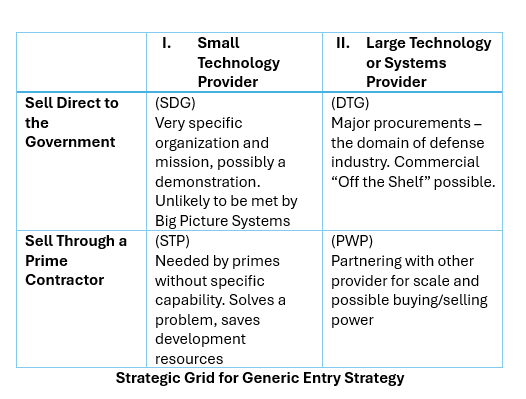
Each of these boxes has major consequences for the potential seller of technology for government application.
Column I - The small technology provider:
- • (SDG) – A small technology provider will have difficulties selling directly to the government because of a lack of familiarity on both sides as well as addressing overhead and complexity of government transactions. Recently, the US War Department established innovation departments (the Space Development Agency, the Defense Innovation Unit, et al) that have significant budgets to develop a technology or system that isn’t available from known qualified suppliers. There is also a set aside of funds to go to “small businesses” which are for-profit, US-based, independently owned, and not dominant nationally.
- • (STP) – This is the common mode of selling through a prime. Characteristically, small technology providers have unique devices and services which the major prime contractors need to satisfy a particular function not developed internally or previously located on the market. They perform “make versus buy” analyses to value whether to develop the needed capability or purchase it from a qualified source. Said qualification is often a barrier to adopting technology from the outside, even if it appears to meet the need better than internal or external alternatives. Done right, STP can satisfy a critical need at an affordable cost, producing a win-win
Column II – the large technology or systems provider:
- (DTG) – Historically, the government and especially the US War Department has gone with a major provider in the form of a defense contractor or aerospace company as with new aircraft platforms like the F35, or GEO satellites like Wideband Global Satcom (WGS). It’s interesting that the former followed the traditional contracting style with detailed requirements down to the unit level and a full panoply of testing and validation demands. The government also introduced the risk-reduction strategy of “fly before you buy”. The latter procurement was an Air Force GEO satellite program in 1999 under the original pejorative title of Wideband Gapfiller to be more of a commercial contract with Hughes Space and Communications (now Boeing Satellite). In the same sense as the F35, the program expanded into a full scope of 12 satellites with still more on the way.. The contracting overheads and pre-contract processes are daunting for a new entrant and few attempt this except in circumstances to be discussed below.
- (PWP) – It is not uncommon for a large provider to engage with another large provider in a kind of joint venture to gain the respect of the government buyer. A good example is MILSTAR, where Lockheed Martin engaged with Hughes Space and Communications to supply an advanced GEO satellite that would guarantee communications under any circumstance, even nuclear war. It will also work at a lower level if the government selects a prime who in turn subcontracts with another prime for either the same kind of need or to “share the wealth” by splitting the work between competent competitors.
Moving Ahead into the Digital Age
This is the digital age in that almost everything new has a digital processor, memory and a network connection. Of course, digital technology has been with us since Touring built the first cypher decoder in 1943, the year after I was born. The war that we fought in the 1960s and 1970s in Southeast Asia wasn’t particularly high tech since much of what we used already existed during WW2 and Korea.
We’ve come a very long way and I marvel at the iPhone and global coverage satellite networks that overcome the last mile problem. The military continues to rely on digital technology both internal to and external from almost every piece of hardware involved with warfighting. Placing assets in space adds another dimension, so to speak, and the current emphasis on communications and earth observation are cases in point. What is within the iPhone can assist the individual soldier, the combat unit such as a company or squadron, and the wide variety of combined forces that place the most effective capabilities where they are needed. That said, the technology that the government needs may already exist or the lack of it can be critical for current and future conflicts.
If we assume that our group has such a technology in hand or our reach, we first need to consider the generic strategies that I’ve introduced above. That’s the kind of effort we see in the past where the new entrant into this field plans and conducts its operation. A good example is how RCA Americom ventured into providing satellite-derived telecom services to the Federal Government, which involved satisfying functional and financial bureaucratic requirements driven by law and regulation. They established a government services subsidiary, employing former military staffers as well as contracting specialists from parts of the parent company already suppling equipment to the government. While I have no direct knowledge, it is what SpaceX would need to do as they offer advanced LEO resources to the government, e.g., Starshield. According to SpaceX,
“Starshield leverages SpaceX's Starlink technology and launch capability to support national security efforts. While Starlink is designed for consumer and commercial use, Starshield is designed for government use, with an initial focus on three areas: Earth Observation with sensing payloads and delivers processed data directly to the user; Communications Starshield provides assured global communications to government users with Starshield user equipment, and Hosted Payloads Starshield builds satellite buses to support the most demanding customer payload missions.”
It's interesting that SpaceX chose the Sell Directly to the Government (SDG) strategy rather than partnering with an established defense contractor or telecom operator (e.g, PWP). LEO constellations are the business of mega corporations, especially when dealing with the government. This is key to assuring proper operation, initially as well as over the long haul. Consider that a future conflict that requires these capabilities by its nature has uncertain future timing. Donald Rumsfeld, Secretary of Defense under President George W. Bush, famously said that you go into war with the military you have. That consists of what’s available at that time and in the hands of able troops and leaders, especially when we see that some conflicts last a matter of weeks (or even days) rather than years. The characteristic of the former model was demonstrated by the Vietnam War and the conflicts in Afghanistan and Iraq where there is time to remodel and adapt to the evolving needs. However, the latter offers the possibility of a quick resolution such as the 12 Day War that halted Iran’s nuclear program.
On the small company scale, I witnessed an interesting presentation at the Satellite ‘23 show in DC by Aalyria of their SPACETIME computation environment for managing complex orbital and terrestrial resources. The technology originated in Google for the defunct Google Loon project in South America, subsequently spun off inside Aalyria. Six months after Satellite ‘23, Aalyria demonstrated how SPACETIME could offer multi-orbit services to fixed and mobile users who require a guarantee of connectivity no matter their circumstances. The government could find this useful today and, in the future, but the question remains as to the nature of the buyer, for example, acting as integrator for an appropriate government capability. Now that the government knows of SPACETIME and has seen it in action, the right prime contractor could take SPACETIME to the next level and potentially buy the company to gain competitive advantage. This is the role of STP strategy.
But STP is the mainstay of the component market, such as optical communications terminals (OCTs), electric thrusters and even complete communications payloads. Several companies offer OCTs for integration on large and small satellites based on technology proven in custom space missions, even cubesats. To date, none has really crossed the chasm between limited production and mass adoption. The possible exception is SpaceX, which developed their own OCT and probably flown thousands by now.
Michael Porter identifies two contrasting business strategies – Cost Leadership and Differentiation Focus. The latter was addressed nearly 50 years ago by Hy Silver in Los Angeles-based seminars on proposal strategy. He taught the importance of customer knowledge, particularly government customer knowledge, as the decision is usually a committee vote and based on consensus. Thus, they evaluate proposals using a set of criteria or Figures of Merit (FOM) that compare material aspects of what basically meet the same need. He explained that if your offer is best technically and lowest in price, you’re expected to win. If you have only one in your favor, then you might win. But if you are poorest technically and highest in price, expect to lose. Low-cost leadership is powerful in basic commodities and some types of products, even launches. But differentiation focus is generally the approach in a particular application where you want your offering to stand out above the alternatives. The government buyer could accept that you don’t have to have the lowest price if there is credible value.
At his seminar, Hy Silver showed an image of a “typical” government evaluator who sits there saying, “I don’t know your company and I don’t know how well you perform”. That’s something that he addresses in his course where you must answer such questions posed by the government in a clear and compelling way. I was working for Hughes Aircraft Company at the time and we had an excellent technical reputation but also a reputation for arrogance. When asked if we could overcome these issues in a proposal, Hy simply said, “with your history of technical success, I could spin gold”. I saw that happen when Hughes won Pioneer Venus, a program that should have gone to a company already doing business with NASA but the Hughes proposal that came out of the Hy Silver methodology proved its worth. The head of NASA phoned Dr. Bud Wheelon, president of Hughes Space, congratulating him on winning. It was said that Bud couldn’t believe his ears and might have dropped the phone.
Selling through a prime is the easiest way to offer your unique product to the government. This is because the prime is already established as a government supplier, including the myriad certifications and staffing to handle acquisition rules, accounting requirements and importantly, security requirements. Even if the overall program is classified, your product can still stay outside of security as long as you meet a number of basic requirements, especially export controls under the ITAR. The prime contractor can handle all of this but you need to listen and follow direction. A good prime will carry you forward, advise you where you must make adjustments, and stand by you throughout the engagement and ultimate final delivery. My father who was in the printing business said that the most difficult sale is when you deliver your product.
Who and How to Develop Your Government Market Entry Strategy
The people who devise marketing strategy must work closely with those that set company business strategy. In a small company, the chief marketing professional, CTO and CEO would be there at all times and participate heavily. As the organization gets larger, there is a trend to have marketing professionals to act for the principals. But, there is a danger here because customers for any of the above business structures want to connect with people who know the product inside and out. It’s no place for the traditional “glad hand” who is supposed to open doors and escort the technical types. This is a layer with a high impedance and a lot of random noise. A payload engineer on a new spacecraft for the prime contractor is more interested in a proven device that meets requirements; information about that is best provided by an experienced counterpart at the prospective supplier under (SWP or PWP).
It’s worth noting here that a new entrant into this sector needs proven technology or at least high confidence in its ability to get there. We apply the concept of the Technology Readiness Level, popularized by NASA and now incorporated throughout government procurement circles. At the highest level:
“TRL 9, which signifies that a technology has been fully flight-proven or successfully deployed in its final, operational form. At this stage, the system has passed all tests, and the technology is ready for full commercial deployment.”
In my past experience, you had to prove to the buyer that your technology met this standard through documented experience and by actual performance data over lifetime and operating conditions. Anything less opens up risk that the device or subsystem will not perform as expected for the entirety of the mission.
Indeed, it takes the smartest and most knowledgeable staff at critical customer meetings and in preparation of the proposal. I’ve said in the past, “you can’t beat the experience.” You find these superstars inside your organization, not amongst high-ranking military retirees. Yes, send them to “smile school” like Hy Silver and Dale Carnegie, but give them the budget they need, keep in contact with them, and back them all the way.
------------------------
 Bruce Elbert is Contributing Editor of the Satellite Executive Briefing magazine and the Founder and President of Application Technology Strategy LLC. (www.applicationstrategy.com) He is a satellite industry expert, communications engineer, project leader and consultant with over 50 years experience in communications and space-based systems in the public and private sectors. Areas of expertise include space segment design and operation in all orbit domains, systems architecture and engineering, ground segment systems engineering, development and operation, overall system performance improvement, and organizational development. He can be reached at: bruce@applicationstrategy.com