



The last decade has been a roller coaster ride in the Latin American FSS market with numerous peaks and valleys in both supply and demand. The decade started out with a mass of satellite launches that drove up supply, but transponder demand lagged leading to a buyer’s market with very low pricing. Then starting in about 2008, demand for capacity, most especially Ku-band transponders, grew very rapidly driven by DTH, video distribution and VSAT networking services for a plethora of rural connectivity, e-governance and USO projects. Little new supply was available at the time, and capacity pricing therefore went up and the tightness in the market in 2009 was evident. NSR estimates that regional average fill rates of commercialized supply were nearly at 80% in 2009 and much higher on the most popular satellites.
Today, the situation is reversing itself with recent or upcoming launches and relocations from the major international operators including Amazonas-2, AMC-4, SES-4, Telstar-14R/Estrela do Sul 2, and SES-6 plus a plethora a new satellites from established and new regional operators in Mexico, Brazil, Argentina, Bolivia and elsewhere. In NSR’s Global Assessment of Satellite Supply & Demand, 7th Edition study, NSR estimated that total commercialized supply for Latin America would increase by more than 40% between 2009 and 2014.
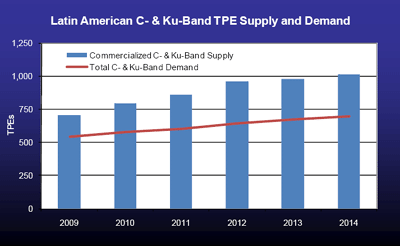 Recent press reports coming out of Brazil also indicate that (barring any unexpected failures), this assessment might even be conservative. Local language reports surfaced on the 26th of January that Intelsat had signed a deal with GVT, a Brazilian telecommunications operator owned by Vivendi, for Ku-band capacity to provision GVT’s new hybrid satellite/IP pay TV service planned for launch later this year. Intelsat is going through the effort to move its Galaxy-11 satellite, currently serving the African market prior to the launch of New Dawn, to be co-located with IS-805 at 55.5 degrees West in order to make available the needed capacity for GVT.
So a fair question to ask is if the Latin American market is about to hit another dip in its roller coaster ride of the last decade. NSR’s current best assessment is that this is unlikely. Even if there is a period of a few years of somewhat lower average fill rates as the new capacity is absorbed into the market, demand remains strong. The GVT deal is a good example, and another recent illustration of this trend is the 3 February press release that TIBA extended its current capacity contracts on NSS-806 with SES World Skies and will lease more than five transponders for the lifetime of the SES-6 satellite planned for launch in 2013 to replace NSS-806.
DTH remains strong in the region, and the launch of HD for cable distribution headends to stay competitive with the surging DTH plays will drive additional capacity demand as well. Plus, the various government backed connectivity projects are seeing sustained growth in not only sites but capacity allocated per site. Reports are surfacing that a new phase of Brazil’s existing GESAC digital inclusion project could require an additional eight to ten transponders of capacity alone!
The above are just a sample of the recent demand drivers, and NSR remains confident that demand growth in Latin America will be adequate to absorb the coming wave of new supply. Just as important, NSR is currently of the opinion that there will be no substantial softening of capacity pricing in the region, at least among the established international and regional operators, as they have all learned the hard lesson of the past pricing wars. An open question remains regarding the impact on the market of some of the new domestic projects. However, if the example in Venezuela of the Simon Bolivar satellite launched in 2008 holds true, then these domestic satellites will have minimal wide scale impact on the Latin American market. If anything, the Latin American roller coaster has gone from a frightening ride to just plain old fun.
Information for this article was extracted from NSR's report: Global Assessment of Satellite Supply & Demand, 7th Edition