



A diverse mix of military leaders, state disaster recovery officials and industry executives shared a range of insights on making the best use of the global satellite communications grid during the three-day ISCe conference organized by Hannover Fairs USA from June 2-4 in San Diego, California.
With its program focused on "SATCOM for Security, Recovery, Victory," ISCe 2009 provided a broad forum for satellite users, planners and providers to discuss both how existing satellite communications networks can meet warfighter and emergency response needs, and how today’s systems and equipment can be improved for even better service in the years ahead.
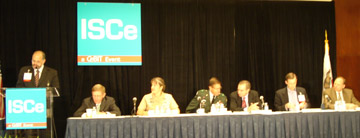
One of the highlights of the conference was a presentation by Lt. Gen. Russel Honoré, U.S. Army (Ret.), who commanded Joint Task Force Katrina during the 2005 disaster. Honoré, a Louisiana native, described the hard lessons learned by disaster planners when the New Orleans communications grid failed during the aftermath of the hurricane that swept through the Gulf coast. Liberally using colorful metaphors to stress his point, Gen. Honoré emphasized that more attention should be focused on preparedness rather than the response to emergencies. Honoré said that being good at responding during disasters is "like being good at closing the door after the pigs have been let out."
At the conference, ISCe again teamed with the Satellite Industry Association (SIA) and the Program Executive Office for C4I to provide the third annual Navy SATCOM Users Workshop on the closing day of the event. The workshop brought together the Navy’s SATCOM leadership, Pentagon planners and satellite industry officials to discuss ways to improve satellite communications to ships at sea and Marines stationed in remote locations around the world.
Several themes dominated ISCe 2009: the emergence of hosted government payloads aboard commercial satellites as a means of getting military assets into space; the importance of satellite communications as a mandatory backup for civil communications networks; and the challenges created by the growing military demand for commercial satellite capacity over Iraq and Afghanistan.
During ISCe’s annual awards luncheon hosted by Intelsat General Corp. and Paradigm Secure Communications, ISCe honored VADM Lyle Bien, United States Navy (Ret.), with its Lifetime Achievement Award. Previous recipients have included David Hershberg (Globecomm Systems) Dr. Harold Rosen (formerly of Hughes), ADM James Ellis Jr. (US STRATCOM), and Dr. Denis Curtin (XTAR). In addition, the ISCe Innovation & Technology Award was presented to the Missouri Department of Transportation for developing its Satellite Emergency Network, while the ISCe Industry Leadership Award went to CapRock Government Solutions for launching the industry’s first managed network services based on commercial X-band.
"ISCe is an ideal forum for government and commercial satellite communications leaders to share not just experiences with how they use today’s systems, but to gain insight into the challenges faced by both sides in planning tomorrow’s satellite networks," said Art Paredes, President of Hannover Fairs USA. "During these tough economic times, it is even more critical that the commercial satellite industry and government and military planners communicate directly with one another on system requirements and funding issues. ISCe provides an opportunity for them to work together as partners and to understand one another’s challenges."
On the final day of the conference, ISCe and Futron Corp. jointly issued the results of their annual survey of conference attendees. The survey found that more than half of the government respondents believe the greatest challenges they faced in using commercial satellite capacity was either integrating it into their existing network infrastructure or maintaining their own staff proficiency in using the capacity. More than two thirds of government respondents said in the survey that the commercial industry understands their needs and procurement requirements. In response to another question, over half of commercial attendees anticipate that future government business will be higher than at present. And three quarters of government respondents anticipate little or no impact from government satellite launches on their commercial satellite use.