



Orbital Sciences Corporation (NYSE: ORB) today reported its financial results for the first quarter of 2012. First quarter 2012 revenues were $338.0 million, up 6% compared to $317.7 million in the first quarter of 2011. First quarter 2012 operating income was $23.8 million, an increase of 136% compared to $10.1 million in the first quarter of 2011.
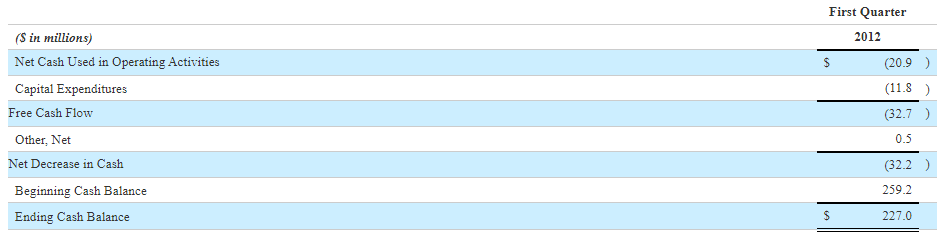
Net income was $13.0 million, or $0.22 diluted earnings per share, in the first quarter of 2012, compared to net income of $12.3 million, or $0.21 diluted earnings per share, in the first quarter of 2011. Orbital’s free cash flow* in the first quarter of 2012 was negative $32.7 million compared to positive $10.8 million in the first quarter of 2011.
Mr. David W. Thompson, Orbital’s Chairman and Chief Executive Officer, said, “The company’s first quarter 2012 financial results reflected steady growth in revenues, operating income and earnings per share. In addition, we successfully completed a number of operational activities during the quarter, including launches of eight sounding rockets, deliveries of seven satellites and launch vehicles for future missions, and the completion of several important construction and testing milestones in the Antares rocket and Cygnus spacecraft programs.”
* “Free cash flow” is a non-GAAP financial measure. For additional details, please refer to the sections of this press release entitled “Cash Flow” and “Disclosure of Non-GAAP Financial Measure.”
Financial Highlights
Summary financial results were as follows:

Revenues increased $20.3 million, or 6%, in the first quarter of 2012 compared to the first quarter of 2011 due to revenue growth in the launch vehicles segment, driven by increased activity on target launch vehicles, and in the advanced space programs segment, driven by increased activity on national security satellite contracts. These increases were partially offset by a reduction in satellites and space systems segment revenues largely due to decreased activity on communications satellite contracts. Launch vehicles segment revenues increased $20.8 million, advanced space programs segment revenues increased $22.3 million and satellites and space systems segment revenues decreased $41.4 million in the first quarter of 2012 compared to the first quarter of 2011. The growth in revenues also reflects an $18.6 million reduction in intersegment revenue eliminations compared to the first quarter of 2011, due to a diminishing level of activity on Antares launch vehicles for the Commercial Orbital Transportation Services research and development program with NASA.
Operating income increased $13.7 million, or 136%, in the first quarter of 2012 compared to the first quarter of 2011, due to higher operating income in the launch vehicles segment and the advanced space programs segment, partially offset by lower operating income in the satellites and space systems segment. Launch vehicles segment operating income improved primarily due to an adjustment in connection with a March 2011 Taurus XL launch failure that reduced operating income in the first quarter of 2011 by $11.3 million. The company also recognized a related $11.3 million insurance recovery that was reported in “other income” in the first quarter of 2011.
Net income in the first quarter of 2012 was $13.0 million, or $0.22 diluted earnings per share, compared to $12.3 million, or $0.21 diluted earnings per share, in the first quarter of 2011. The company’s effective income tax rate increased to 38.0% in the first quarter of 2012 compared to 35.3% in the first quarter of 2011. The tax rate in 2011 included the effect of federal research and development tax credits that are not expected to be available to the company in 2012.
Segment Results
First quarter operating results by business segment were as follows
Launch Vehicles

Launch vehicles segment revenues increased $20.8 million in the first quarter of 2012 compared to the first quarter of 2011 primarily due to increased production work on target launch vehicles partially offset by decreased activity on missile defense interceptors.
Segment operating income increased $13.9 million in the first quarter of 2012 compared to the first quarter of 2011 primarily due to an adjustment in connection with a March 2011 Taurus XL launch failure that reduced operating income in the first quarter of 2011 by $11.3 million and increased production work on target launch vehicles. Segment operating margin increased principally due to the effect of the first quarter 2011 launch failure adjustment.
Satellites and Space Systems

Satellites and space systems segment revenues decreased $41.4 million in the first quarter of 2012 compared to the first quarter of 2011 largely due to decreased activity on communications satellite contracts.
Segment operating income decreased $2.9 million in the first quarter of 2012 compared to the first quarter of 2011 primarily due to decreased activity on communications satellite contracts. Segment operating margin decreased slightly principally due to somewhat lower profit margins on communications satellite contracts in 2012 compared to 2011.
Advanced Space Programs

Advanced space programs segment revenues increased $22.3 million in the first quarter of 2012 compared to the first quarter of 2011 due to increased activity on national security satellite contracts partially offset by decreased revenues on the Commercial Resupply Services (CRS) contract with NASA.
Segment operating income increased $2.7 million in the first quarter of 2012 compared to the first quarter of 2011 driven by increased activity on national security satellite contracts. Segment operating margin increased in the first quarter of 2012 due to profit margin improvements on national security satellite contracts.
Cash Flow
Cash flow for the first quarter of 2012 was as follows:
New Business Highlights
During the first quarter of 2012, Orbital received approximately $295 million in new firm and option contract bookings. In addition, the company received approximately $85 million of option exercises under existing contracts. As of March 31, 2012, the company’s firm contract backlog was approximately $2.1 billion and its total backlog (including options, indefinite-quantity contracts and undefinitized orders) was approximately $5.2 billion.
Operational Highlights
In the first quarter of 2012, Orbital successfully carried out eight suborbital sounding rocket launches and completed several important construction and testing milestones on the Antares rocket and Cygnus spacecraft programs. In March, Orbital’s Technical Services Division supported the launch of five company-built suborbital sounding rockets in a seven-minute period for NASA from Wallops Island, VA in a mission to gather scientific data about the Earth’s upper atmosphere. Orbital also delivered one satellite and six launch vehicles to customers for future deployments, including the NuSTAR astrophysics satellite, an Orbital Boost Vehicle missile defense interceptor and several target vehicles. In addition, Orbital successfully conducted the first international launch of its Coyote supersonic sea-skimming target missile for the French Navy in early April.
In its Antares and Cygnus product development programs, Orbital delivered the fourth Antares rocket airframe to its final integration site and oversaw the substantial completion of construction of the launch pad complex at Wallops Island. In early April, the company rolled out the first Antares vehicle to the launch pad and conducted mechanical and electrical fit checks and horizontal-to-vertical rotation of the vehicle to its launch position. Also during the quarter, the first two Cygnus spacecraft service modules completed thermal vacuum, vibration, acoustics and solar array testing at the company’s Dulles, VA satellite production facilities.
For the remainder of 2012, Orbital plans to conduct approximately 20 major space missions. These events are expected to include the first two flights of the company’s Antares rocket and the initial mission for the Cygnus spacecraft to the International Space Station. Additionally, Orbital is planning to deliver up to five commercial communications satellites to customers, at least four of which are slated to be launched during the year, as well as to launch two Pegasus rockets and numerous target vehicles and other suborbital rockets.