

SpaceX was never going to be a “quiet” company. From its early days in 2002 it has attracted publicity, some good but much of it highly critical both of its objectives and of its ability to achieve them.
Given that SpaceX was founded in 2002 by internet entrepreneur Elon Musk – who at the time had no history in the space business and the two stated objectives of the company were:
- to reduce the cost and reliability of space access by a factor of ten, and
- to enable humanity to become a space faring nation.
It is hardly surprising that those with a longer history in the business felt somewhat sceptical about those two very ambitious goals. Particularly in view of the fact that the unlike other US launch vehicles the initial development was not going to be supported by government money.Eight years later SpaceX has made some significant strides and along the way picked up a third objective: that of transporting supplies and eventually crew to the International Space Station (ISS). The COTS (Commercial Orbital Transportation Services) Program announced in January 2006 was NASA’s response to President Bush’s 2004 directive to promote commercial participation in Space. In August 2006 after two rounds that attracted over a dozen entrants, including some well established names in the industry, two awards were made. One to SpaceX for US $278M and the other to Orbital Sciences for $170M. The COTS awards are to demonstrate delivery and return of cargo to the ISS, something very necessary given the retirement of the Space Shuttle at the end of this year and pending cancelation of the Constellation Program. SpaceX will receive the $278M ONLY when it has met the requirements of the award. If it fails to meet any of the milestones the award can be withdrawn or renegotiated. For SpaceX this means three Falcon 9 demonstration flights carrying the Dragon spacecraft. On the first flight the Dragon will have to perform a series of manoeuvres in space and return to earth. On the second COTS flight the Dragon will have to manoeuvre within grapple range of the ISS and maintain position and the third flight will be a cargo run to and from the ISS. The award also contains an option for COTS-D which would be three demo flights of a manned version of Dragon.
So with those three bold objectives it is not surprising that there was a great deal of interest and tension surrounding the June 4thfirst launch attempt of Falcon 9.
As would be expected first launches are prone to failure as SpaceX experienced with the initial Falcon 1 launches. On June 4ththere was an additional handicap – a 40% chance of cancellation of the launch due to unsuitable weather conditions. The launch window was between 11am and 3pm EDT. Given that a major storm was expected at 1pm it was hoped to launch early in the window. The next launch attempt was scheduled for 1pm, but was aborted just before the 15 minute countdown started. This time the problem was a sailboat that had strayed into the no-sail zone off the Florida coast. The Air Force were sent out to intercept it. The next launch attempt was scheduled for 1pm, but was aborted just before the 15 minute countdown started. This time the problem was a sailboat that had strayed into the no-sail zone off the Florida coast. The Air Force were sent out to intercept it.
At 1:15 the 15 minute countdown started again. Although the cloud cover was low there was no sign of the expected storm. For the next 14 minutes everything went smoothly and CNN, Fox and local TV stations were all manning their cameras, surrounded by reporters sporting everything from massive SLRs overweight with lenses to tiny cameras on cell phones....but we were all looking in the same direction and holding our breath. At T minus 1 second the launch was aborted. At this point the launch was being controlled entirely by computers and an engine parameter had fallen out of range.
At 2pm with only an hour left we learnt that SpaceX was going to try again. The clouds were still heavy but still no storm.
At 2:30 the 15 minute countdown resumed. By now the clouds had cleared and we were looking at blue skies with only a few scattered clouds – much better for launch viewing! For the fourth time that day we all assumed the launch position – cameras at the ready. This time we – and more importantly SpaceX – were rewarded by the sight of a perfect launch at 2:45!
Subsequent press releases from SpaceX indic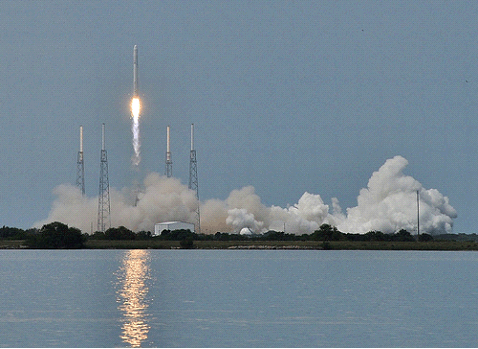 ated that Falcon 9 achieved all of its primary mission objectives, including a "nearly perfect insertion" of the dummy Dragon into a 155 mile high circular orbit. SpaceX is intending to make all parts of Falcon 9 reusable as part of its program to reduce cost. On this occasion it proved impossible to recover the stage one rockets and Elon Musk (Founder, CEO and CTO) commented that it may take several flights before they succeed in this.
So where does SpaceX stand now, in relation to the three objectives? Even before the launch SpaceX boasted an impressive manifest with over 30 launches booked representing a mixture of commercial and government contracts. Twelve of these are part of the CRS (Cargo Resupply Services) contract with NASA to deliver a total of 20,000kgs of cargo to the ISS. This contract is valued at $1.6bn and there is a possibility of an additional $1.5bn for subsequent missions. Even without the follow-on missions, IF Falcon 9 and Dragon meet the COTS requirements then SpaceX will be well on the way to meeting its third objective. The second Falcon 9 - which will be the first COTS flight - is assembled and waiting transport to Cape Canaveral for a launch later this year.
The Falcon 9 Rocket was successfully launched from Cape Canaveral, Florida on June 4, 2010. ( Photo courtesy of Tom Patton, Broad Reach Communications, tom@tcpatton.com)
As for "enabling humanity to become a space faring nation", the Dragon capsule that will be used to ferry cargo to the ISS has been designed so that it can easily be converted into a crew ship and the CRS cargo includes live plants and animals. SpaceX claims that it can provide a rapid transition to transporting astronauts within three years of receiving a contract to do so. Nevertheless transporting crew to the ISS hardly makes humanity space faring nation. It is likely to many years before this objective is achieved and I very much doubt that it was ever intended to be otherwise.
The commercial contracts are both for Falcon 1 and Falcon 9 and include orders from ORBCOMM, Astrium and SS/L. Falcon 1 got off to a shaky beginning with three launch failures, but last July it successfully launched RazakSAT for Malaysia. Falcon 1e is capable of putting 1,010Kg in a LEO orbit. Falcon 9 when it’s not ferrying cargo to the ISS is slated to be capable of putting 4,680Kg to a GTO or 8,500 to a LEO orbit putting it roughly on par with a Delta IV or Proton. Falcon 9 Heavy which will follow on is slated to be capable of taking 19,500kg to a GTO, making it one of the most powerful launchers around.
There are not many websites that I know of that quote fixed prices when those prices involve millions of dollars, but that is exactly what SpaceX does. A Falcon 9 GTO launch is $56M, just over half the cost of a similar Proton launch. So maybe not a reduction by a factor of ten yet, but a very impressive start and one that has the potential to change the face of the commercial launch industry if things continue as envisaged.
---------------------------------
 Elisabeth Tweedie has over 20 years experience at the cutting edge of new communication and entertainment technologies. She is the founder and President of Definitive Directiona consultancy that focuses on researching and evaluating the long term potential for new ventures, initiating their development and identifying and developing appropriate alliances. During her 10 years at Hughes Electronics she worked on every acquisition and new business that the company considered during her time there. www.definitivedirection.comShe can be reached at:etweedie@definitivedirection.com +1 310-292-0755 or +44 (0)7768 610574.