

by Helen Weedon
Lampeter, Wales, UK, November 6, 2026--Military operations have evolved to become progressively multi-domain, geographically dispersed, and data heavy. While in the past, defence organisations may have been at the forefront of satcom innovation, in recent years, this has switched with commercial providers now leading that charge. As a result, defence organisations are increasingly leaning on commercial satcom providers to deliver the flexibility, scalability, and redundancy that modern missions demand.
Aside from the political challenges that combining commercial and military networks creates, a number of technical considerations also arise. Military operations require technology that is reliable, rugged, secure and flexible, so any commercial solutions installed within government networks must of course meet these key requirements.
When it comes to combining commercial and defence networks, interoperability and seamless handovers between different systems is obviously a critical factor. Consequently, orchestration clearly plays a vital role in making hybrid networks operationally viable.
Role of Commercial Solutions
The dedicated military satcom systems built to serve the military requirements in the years gone by were not designed for the sheer scale, tempo, and distribution of current missions. This has created a gap that has pushed military organisations to integrate commercial solutions and networks into their architectures.
Commercial providers have invested heavily in developing next-generation satcom technology such as multi-orbit/multi-band connectivity, virtualisation and software-defined infrastructure, and the speed of development is fast. Matching this pace of innovation is difficult for defence programmes, primarily because of the long procurement cycles and extensive validation processes. The result is an environment in which commercial networks are playing a growing role in providing capacity, mobility, and flexibility for defence organisations.
Real-world deployments show how deeply integrated commercial solutions have become in modern military networks. Perhaps the most obvious is the use of commercial LEO networks which with their low latency and ease of deployment, are now widely used by defence organisations to provide critical connectivity on the battlefield. While LEO constellations are playing an increasingly bigger role in military communications, it’s also recognised that depending on a single network is a dangerous road to go down. The antidote to this is the use of hybrid networks to achieve increased redundancy and resilience. And if these networks combine multiple orbits, users can leverage the various advantages and characteristics that each orbit offers.
That said, some sovereign governments prefer not to have their sensitive information flowing over commercial third nation networks and this is driving an increase in joint procurement of commercial satellites that feature software defined payloads to allow the flexibility they require.
Yet blending all of these disparate components is no walk in the park: interoperability and effective orchestration are critical.
Technical Considerations when Installing Commercial Solutions in Military Networks
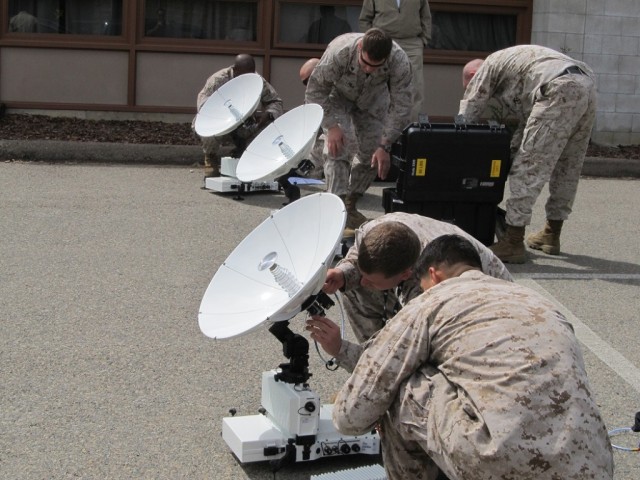
Military users assess satcom technology through a narrower lens than commercial counterparts. Reliability, deployability, ruggedness, interoperability and flexibility are all critical factors. When commercial equipment enters military environments, it must meet these criteria without losing the agility that makes it attractive.
Interoperability is of course a key consideration because data must be able to move seamlessly and reliably between sovereign GEO systems and commercial networks operating across orbits. Achieving that kind of seamless interoperability is technically demanding, which is why orchestration has become central to future architectures.
Networks must be able to understand the state of each available link, and route traffic accordingly without requiring users on the ground to think about which system they are using. Defence organisations require effective network virtualisation software to enable them to oversee and manage different networks from a central point.
Another major challenge is resilience in the face of deliberate interference and jamming. Military satellite links are subject to cyberattacks and electronic warfare pressure that is far more intense than in typical commercial networks. Although commercial operators naturally incorporate interference mitigation and anti-jamming features into commercial networks, for military use, there needs to be multiple layers of technology all working together to provide military-grade security.
Achieving seamless handovers between separate networks and systems is another technical challenge. Switching from a GEO satellite to a commercial constellation is a complex operation, particularly when it must be done without any loss of service. Beam patterns vary, network management systems do not always align, and terminals must coordinate across disparate architectures. For handovers to work in the field, orchestration systems need a unified view of the available networks and an understanding of mission priorities.
Procuring technology with the latest up-to-date capabilities also remains a challenge because military procurement cycles tend to be extremely long. This is one of the factors that is driving defence organisations to increasingly employ satcom as a service contracts. Not only does this grant access to the latest technology, but it also shifts operational responsibility onto commercial operators who are able to react quickly to changing requirements. The use of AI and ML could also potentially help to streamline and essentially speed up supply chains and efficiency of procurement cycles.
Where Integration is Heading
What’s become crystal clear in recent years is that no single system can possibly meet all mission requirements, and military satcom can no longer remain isolated from commercial infrastructure. Hybrid networks are emerging as the only realistic way to support operations that span vast distances, involve multiple domains, and rely on rapid flows of information. Dedicated military systems will still play a vital role, but they cannot deliver the scale or adaptability needed for today’s environment without commercial partners.
With this in mind, there is without a doubt, a need for greater collaboration, both on the government side, and on the commercial side, than the sectors have been used to.
Standardisation is also gaining momentum as virtualised ground systems and software defined networking become more common. Borrowing principles from terrestrial telecoms allows different systems to work together more naturally and helps create the foundation for the multi-orbit, multi-band environments that defence organisations now need.
While none of us knows what’s around the corner, the direction of travel seems clear. Commercial and defence satcom networks are steadily moving towards a more integrated model where networks that were once distinctly separate, are becoming increasingly merged and connected. In this blurred landscape, commercial providers will continue to advance satcom technology and make new capabilities available for the commercial market, which can then be customised to meet specific defence needs.
--------------------------------

Helen Weedon is Managing Director of the Satcoms Innovation Group (SIG) which is dedicated to promoting innovation within the satellite industry. Helen has been involved with SIG since 2011, previously supporting the group with marketing, PR, and admin activities. Helen has over 20 years’ experience within the satellite and broadcast industries. She is the founder of Radical Moves, a specialist PR and Marketing agency. Helen is fluent in French, German, and Welsh, with a basic knowledge of Dutch and Spanish. Helen regularly addresses the industry on the challenges faced by the satellite industry and the innovative approaches needed to resolve them. She can be reached at: helen@satig.co.uk