

by Aishwary Pachaury
Bengalaru, India, November 9, 2026--The boundary between Satellite communications (Satcom) and Earth observation (EO) is narrowing as incumbents seek new revenue streams and EO providers pursue faster delivery of usable intelligence. Expansion into remote sensing and analytics is taking different forms: Space42, SKY Perfect JSAT, MEASAT and Thaicom illustrate routes through mergers, investment and partnerships. In the other direction, ICEYE is developing sovereign connectivity solutions with Nokia, while Planet and SES Space & Defense have tested satellite relays to accelerate EO data delivery. These moves share a commercial logic, not a single business model: communications operators want more value from existing customer relationships, while EO providers want their information delivered and used sooner. Customers, meanwhile, want fewer integration tasks between acquiring data and acting on it, and a clearer route to operational intelligence and turnkey solutions.
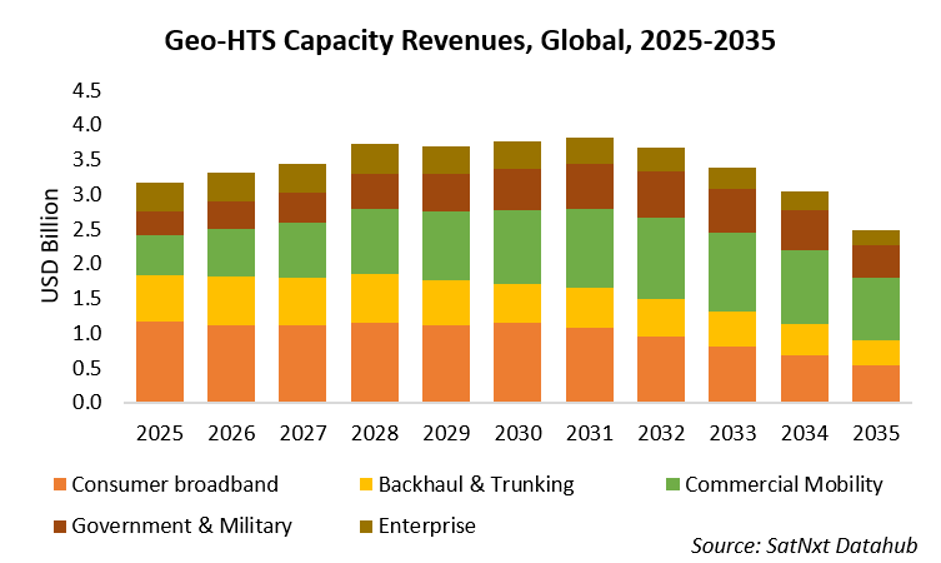
Geo incumbents are witnessing massive competition from the LEO satcom capacity. This is resulting in accelerated price erosion, customer churns and revenue decline. According to SatNxt Global Satcom market forecast, the Geo-HTS revenues decline from US$ 3.17 billion in 2025 to US$ 2.49 billion in 2035, down 21.3%. Mobility and government demand offer interim growth but cannot sustain the aggregate trajectory. This supports a diversification thesis, and hence the industry incumbents are looking for opportunities beyond connectivity.
 EO Opens a New Route Beyond Connectivity
GEO incumbents have several responses to pressure on connectivity revenues: add LEO capacity through multi-orbit offerings, consolidate assets, or move downstream into managed services. EO offers a unique form of diversification - expanding based on their customer needs & demand growth, rather than only how they deliver connectivity. Combined with analytics and AI, imagery can underpin monitoring and intelligence services for customers already buying communications. The strategic fit is strongest where existing customer relationships, local support and secure delivery can be combined with specialist sensing and analytical capabilities.
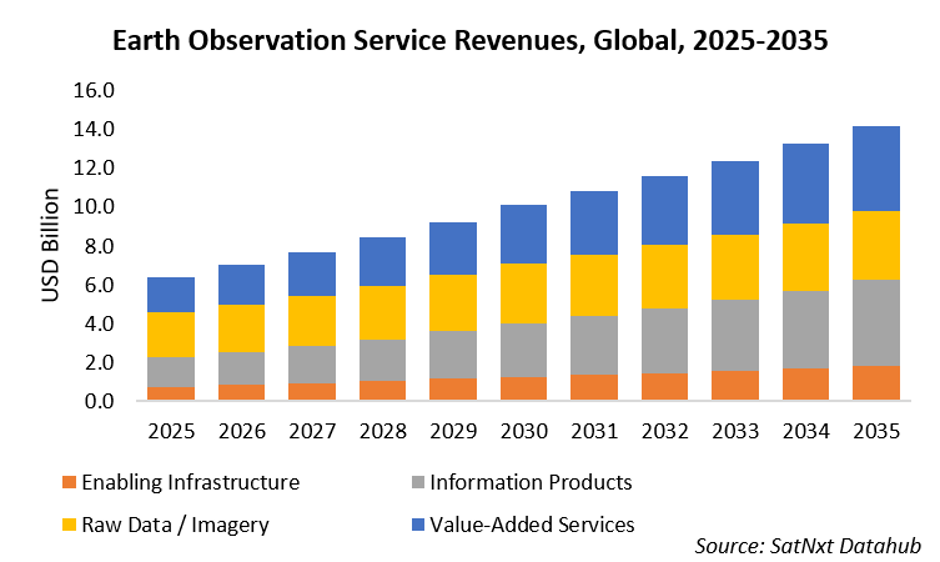
SatNxt’s EO market assessment reinforces that rationale: projected revenue rises from US$ 6.42 billion in 2025 to US$ 14.18 billion in 2035, while information products and value-added services grow from 51.9% to 62.0% of the total. The opportunity is therefore not simply to own imaging satellites or distribute raw data, but to turn observations into usable outputs and deliver them within customer workflows. Incumbents should prioritise applications where they have customer access and a credible delivery role, partnering for missing capabilities rather than assuming that market growth alone makes EO an attractive investment.
Convergence in Practice: Portfolios, Sovereignty and Speed
Portfolio expansion is proceeding through ownership and partnerships, but the commercial objective is the same: combine data acquisition with services customers can use. The Yahsat-Bayanat merger brought communications, geospatial analytics and AI together within Space42. In June 2026, the company reported Foresight-3, -4 and -5 operational, taking its SAR constellation to five satellites, with 25-centimetre imagery feeding GIQ. MEASAT’s stated partner-led offering spans optical, SAR and short-wave infrared imagery and analytics; its February 2025 SPACESAIL memorandum includes potential EO cooperation alongside broadband, direct-to-device communications and satellite IoT. SKY Perfect JSAT is combining investment in LEO EO satellites with Japanese sales of constellr thermal-infrared data, launched in February 2026 for wildfire detection, infrastructure monitoring, maritime security and industrial activity. Thaicom’s CarbonWatch adds application-specific analysis: in July 2024, it announced TGO certification of its satellite-and-AI tree-carbon assessment method under Thailand’s voluntary emissions programme and a Mae Fah Luang Foundation partnership. Its September 2026 renaming as Gulf Space Technology signals broader data-services ambitions. These models target downstream spending, but a broader portfolio is only the starting point, the test is whether sensing, analytics and local delivery work together.
 Sovereignty strengthens the case for integration where governments want control over sensing and communications rather than access alone. Japan’s Tri-Sat Constellation, established by SKY Perfect JSAT, Mitsubishi Electric and Mitsui, signed a ¥283.1 billion defence imagery contract, including tax, on 19 February 2026, running through March 2031. Synspective, QPS Institute and Axelspace participate in the wider consortium; the value is Tri-Sat’s contracted portion, not JSAT’s standalone revenue. ICEYE and Nokia approach the same demand from the connectivity side. Their October 2026 partnership proposes sovereign broadband systems spanning satellites, ground infrastructure and terminals, extending ICEYE’s sovereign SAR-intelligence model into communications. First launches are expected in 2028, while a 22 October letter of intent with Ukraine’s defence ministry signals interest rather than procurement. Control and resilience underpin the strategic fit; operational delivery remains a future milestone.
Delivery speed creates a different incentive to collaborate: timely information requires both sensing and a reliable route to the customer. Planet and SES Space & Defense are testing that link. In December 2025, Planet reported an error-free, 1 Mbps Ka-band relay from a Pelican satellite at 500 kilometres through O3b mPOWER at around 8,000 kilometres to Manassas, Virginia, under NASA’s Communications Services Project. Relaying data can reduce the wait for direct ground-station contact, helping EO providers accelerate disaster-response and intelligence information without building their own communications constellation. SES launched a follow-on payload aboard Pelican-12 in October 2026, equipped with a software-defined radio and tracking antenna for further testing. These milestones validate the relay approach; a guaranteed operational, near-real-time service remains to be demonstrated. Faster transport creates customer value only when processing and dissemination keep pace.
Compete on the Mission and Prove the Economics
For GEO incumbents, customer needs should determine the investment case and the capabilities required. Prioritise where customer access, local support and communications expertise provide an advantage, then acquire or partner for the missing sensing and analytics capabilities. EO providers should make collection-to-customer latency part of the product proposition, alongside solution performances. For both, pricing power and profitable growth depend on repeatable demand and disciplined management of integration costs.
Advanced and integrated services sellers should translate the turnkey promise into measurable commitments on delivery time, analytical output, availability and data control, and solution economics. Industry stakeholders should distinguish operational services and contracted demand beyond demonstrations, memoranda and letters of intent. The Satcom-EO boundary is narrowing; commercial success will depend on who can integrate the chain, take responsibility for delivery and earn a return.
----------------------------------

Aishwary Pachauri is a Consultant at SatNxt. Aishwary is a strategy and growth consultant with over a decade of cross-sector leadership experience spanning finance, space, education, and building materials industry. He specializes in commercial strategy, corporate planning, pricing architecture, and data-driven market expansion initiatives. His consulting portfolio includes advising clients across India, and the USA, delivering actionable insights for geographic expansion and revenue optimization. At SatNxt, he brings a global, cross-functional perspective to market intelligence and strategic advisory engagements, helping organizations translate complex insights into scalable growth strategies. He can be reached at: aishwary@satnxt.com