



by Elisabeth Tweedie
Los Angeles, Calif., March 10, 2026 --When SpaceX launched Starlink in 2019, the industry changed forever. Geosynchronous satellites (GEOs) had long been the dominant, indeed until the launch of O3b service in 2014, the only way, to access commercial space-based broadband communication services. The first generation of O3b, a medium-earth orbit (MEO) constellation had limited capacity and only served a small segment of enterprise satellite users. Starlink as a low-earth orbit constellation (LEO), offered a very different service. Due to significantly increased capacity provided by thousands of satellites, coupled with the lower bandwidth prices made possible by a vertically integrated supply chain, consumer broadband service became a viable service from non-geostationary satellites (NGSO). However, with service being provided on a “best effort” basis, few enterprise customers were interested.
Starlink is no longer the only game in town. OneWeb, now part of Eutelsat is also operational. With the recent launch of 32 satellites, Amazon LEO now has over 200 satellites of the planned constellation of 4,500 satellites in orbit. There are another 20 launches planned for this year, and Ricky Freeman, stated at World Satellite Business Week, last September, that it plans to start offering service in five markets in late 2026.
Starlink, OneWeb and Amazon will not be the only operators. There are numerous other filings for proliferated LEO constellations. These include: LightSpeed (from Telesat), Europe’s defense system, Iris2, TerraWave from Blue Origin, and the Chinese constellations GuoWang and Qianfan (also known as SpaceSail).
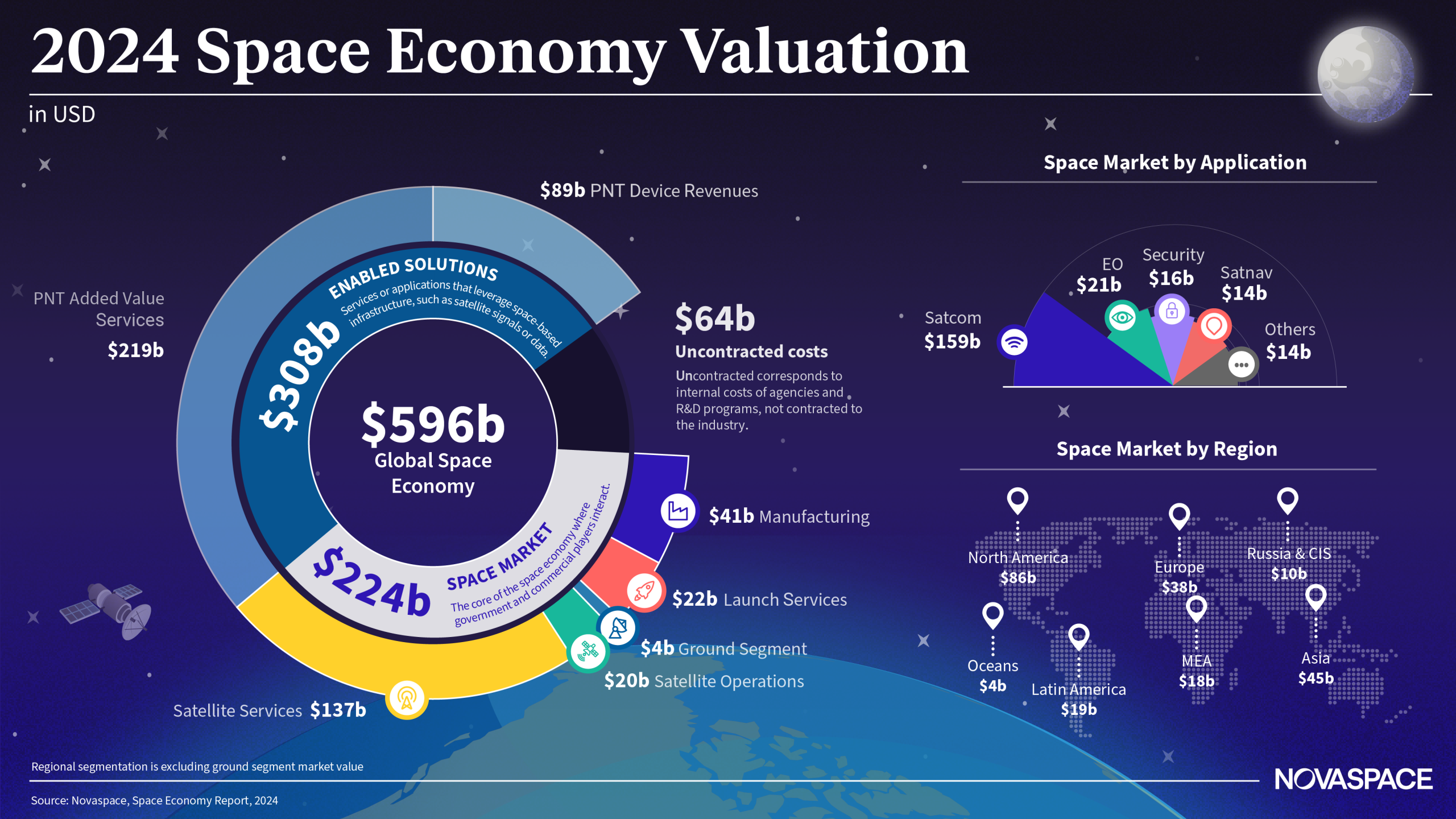
According to a recent report from Novaspace, the global space economy is projected to have a 12% compound annual growth rate (CAGR) in the ten years to 2034, to reach a value of US$1.01 trillion. There are several factors driving this growth: global unrest, leading to increased government and military demand for surveillance and operations, the prospect of putting data centers in space, and of course, the proliferation of LEO satellites. A year ago, Goldman Sachs predicted that there would be over 70,000 operational LEO satellites by 2032. That of course was before Starlink filed for an additional one million satellites, and Blue Origin announced TerraWave, a MEO-LEO constellation of 5,408 satellites. However, there is now another key driver: multi-orbit communications. Thanks to innovations in the ground segment, this is now not only possible, but becoming essential for most segments, with the exception of consumer broadband.
Multi-Orbit Services
Speedcast was one of the first independent service providers to start offering multi-orbit services by combining service from Starlink with connectivity from GEO satellites in one service offering. This was a game-changer for the industry, as the combination meant that service level agreements (SLAs) and committed information rates (CIRs) could be offered in conjunction with LEO broadband, making them attractive for enterprise level connectivity, where continuity of service is of vital importance.
The traditional GEO satellite operators have also been quick to realize that a multi-orbit strategy is now becoming a necessity. Many would say that that was one of the reasons behind Eutelsat’s acquisition of OneWeb. Interestingly, prior to the acquisition, OneWeb was already in partnership with Intelsat and this partnership remains, meaning that with SES’ acquisition of Intelsat, SES can now offer service in all three orbits. Not to be left out, ViaSat, one of the major GEO operators is partnering with Telesat to use Lightspeed, Telesat’s LEO constellation, scheduled to begin service during 2027.
Naturally, a multi-orbit service combines the “best” features of each orbit. LEOs provide low-latency near global coverage and high bandwidth. MEOs also provide high bandwidth, but are geared towards government and enterprise users and therefore come with on-the-ground support as standard. GEOs have wide-area footprints and some of the more recently launched satellites also provide steerable beams that can for example be moved to areas of temporary high demand; major sporting events, war zones or areas of natural disasters for example.
These features vary in importance depending on the segment and even individual customer. For the Military and Government Sector, the prime advantage is resiliency and redundancy. Combined orbits provide mission assurance architecture. If one orbit or frequency experiences jamming, the signal can seamlessly be moved to another orbit. A multi-orbit service comes with built-in redundancy, so there is always backup if, for example, adverse weather conditions compromise bandwidth. The low latency from a LEO or MEO system is very important for tactical operations, whilst a national GEO satellite will provide sovereignty and secure gateways.
For Aviation, a multi-orbit strategy provides a seamless gate-to-gate service, a consistent passenger experience and global coverage, including over polar routes. It also has the potential to provide additional capacity at major airports, landing rights in more countries and SLAs, so no more dropped connections mid-movie. Passengers today, expect to receive the same experience in the air that they do at home, so consistent high-speed connectivity, which can only be guaranteed with SLAs becomes a competitive advantage, as does the lower price point for LEO service, leading many airlines to provide free connectivity as a differentiator.
Cruise passengers have the same expectations as airline passengers, so being able to provide affordable, consistent broadband is a key differentiator. Similarly for merchant shipping, the crew, who may spend many months away from home, also want that reliable connectivity. But maritime connectivity is not just about the personal needs of passengers and crew. Merchant shipping and fisheries need to keep in regular touch with shore management and need weather updates. So for the maritime industry, global connectivity is important, as is the resiliency provided by the ability to provide continuous service. Also, with the opening of the north-west passage, coverage of the polar region is of increasing importance. Historically, this has been a “dead zone,” as coverage from a GEO is virtually impossible due to the look angle.
Orbital Connect – Growth and Reputation
One company that is very focused on providing multi-orbit connectivity for its customers is Orbital Connect. Just six years old, Orbital Connect continues to grow with the industry. Initially, a reseller of RF ground equipment for the satellite industry, now emerging as a true powerhouse; Orbital Connect supplies equipment, service and most importantly tailored technical solutions for complex projects for its customers.
Putting together a complete satcom solution is a challenging task, particularly in today’s multi-orbit environment. A complete communication network usually depends on ground equipment from several different vendors flawlessly working together: antennas, modems, hubs, amplifiers, block up and down-converters etc. For the customer this can be a challenging task. Assembling the network requires knowledge and understanding of different vendors and pieces of equipment, and how to integrate them all. A daunting task initially, and a horrendous task when something goes wrong with an operational network. A far better solution is to work with a skilled and reputable integrator such as Orbital Connect, who can not only design the system, but can also install it and provide after-sales service.
“...A multi-orbit service combines the “best” features of each orbit. LEOs provide low-latency near global coverage and high bandwidth. MEOs also provide high bandwidth, but are geared towards government and enterprise users and therefore come with on-the-ground support as standard. GEOs have wide-area footprints and some of the more recently launched satellites also provide steerable beams that can for example be moved to areas of temporary high demand...”
Orbital Connect now offers over 30,000 pieces of equipment from over 65 manufacturers, including many of the leading names in the industry: ST Engineering iDirect, Kymeta, Cobham, Intellian, Calian, Work Microwave, Novelsat, Paradigm Communications, SES, Iridium, Speedcast, OneWeb, Globalstar etc.. These companies are proud of their reputation, so distributors have to meet stringent requirements before being allowed to represent them; therefore customers working with Orbital Connect can feel confident that they are working with a well-qualified and knowledgeable distributor.
Orbital Connect has grown with the industry and with its customers. As it established itself as a reliable supplier of quality RF equipment, customers turned to Orbital Connect for products in other parts of the value chain. Consequently, its product portfolio grew to encompass multiple categories in the ground segment. At the same time Orbital Connect strengthened its reputation by becoming a certified partner for many of the industry’s leading names.
Now, Orbital Connect’s range of equipment offerings includes:
- Antennas
- Ground stations
- Modems
- Hubs
- Converters
- RF over fiber
- Monitoring and measuring equipment
- Broadcast contribution and headend solutions
- Spare parts and accessories.
As part of its progress towards being a full-service integrator, Orbital Connect continues to grow and educate its workforce, gaining both US Government Federal: SAM, FRN, NIST certifications as well as many commercial certifications including:
- Norsat Introduction to Satellite terminals
- iDirect Silver Partner Certificate
- Intellian Certified Partner
- Inmarsat FX Instalation Certified staff
- Iridium LT 3100S GMDSS Technical installation Certified staff
- Profen Silver Partner
- Peplink Gold Partner
- Kymeta Certified Partner
- Credlepoint Certified Partner
- ISO 9001:2015
As customer expectations and needs shifted from hardware procurement to full-service integration and installation, Orbital Connect grew to meet those needs, by expanding and training its workforce and partnering with certified installation companies, so as to be able to support projects in many regions, so as to ensure that the solutions delivered are fully operational and tailored to local conditions.
Today, it is able to offer network configuration, integration, installation, testing and full deployment. As an Speedcast Partner it has access to over 30 teleports, all World Teleport Association (WTA) certified tier 3 or 4 and is able to provide colocation as well as end-to-end connectivity service connecting to the terrestrial backbone. Orbital Connect itself is also a WTA member
Orbital Connect has a well-trained workforce and project support covers everything from analysis and design to full operational deployment and post-sales support should the need arise. By combining proven hardware from leading manufacturers with systems integration and installation expertise, with a network of global teleports, Orbital Connect is able to provide customers with a seamless path to reliable network service. Whether that be fixed VSAT, maritime VSAT, satcoms on the move (SotM), Starlink, OneWeb, or 4G LTE/5G.
Looking to the Future
Utilizing their knowledge and close relationships with equipment suppliers, the team at Orbital Connect have created a solution tailored to the needs of the earth observation industry. Working closely with Cobham and Work Microwave, Orbital Connect has created a fully integrated ground station solution for LEO earth observation (See Product Spotlight on page 8).
The earth observation system is just one example of how Orbital Connect is growing with the industry. Initially its ground segment products were VSATs dedicated to GEO satellites, now, as already described, it provides equipment for Starlink and earth observation LEO satellites.
With its stellar reputation, it is not surprising that customers are now asking for more than just ground segment equipment. They are looking to Orbital Connect for the “complete package,” including the space segment. Entering this segment requires considerable planning, not only is it essential to establish relationships with the bandwidth providers, it is equally essential to have staff that understand this segment of the value chain and can provide the high caliber service that Orbital Connect has built its reputation on. Recruitment and training is underway, and in the last few months Orbital Connect has recruited someone to focus on the maritime sector and someone to focus on after-sales support.
Given its attention to customer satisfaction, coupled with its deep understanding of the industry, it is no surprise that Orbital Connect has a stellar lineup of both government and commercial customers. These include: Aerospace Corporation, SES, OHB Sweden, Globecast Americas, Telespazio, L3 Harris, Northrop Grumman, iHeart Radio and Raytheon on the commercial side and the US DoD, the United Nations, the US Agency for Global Media, the US Antarctic Program, the US House of Representatives and the JKU University of Linz. As it expands to become a full service operator, as well as an equipment supplier, there is no doubt that this list of reputable clients will continue to expand.
-------------------- Elisabeth Tweedie is Associate Editor of the Satellite Executive Briefing magazine and has over 20 years experience at the cutting edge of new communications entertainment technologies. She is the founder and President of Definitive Direction (www.definitivedirection.com), a consultancy that focuses on researching and evaluating the long-term potential for new ventures, initiating their development, and identifying and developing appropriate alliances. She can be reached at: etweedie@definitivedirection.com