



by Claude Rousseau
Strasbourg, France, May 8, 2026--The demand for computing and storage in space missions is growing. This can be illustrated by comparing the capabilities of the guidance computer system used in the first Apollo mission that landed humans on the Moon and those of the systems typically used today. The former had 2KB of RAM and 72KB of storage, while modern computers usually have 64GB of RAM and 0.5–1TB of storage. That equates to 32 million times more RAM and 7–15 million times more capacity.
Data centers (DC) are increasingly needed in orbit to serve an expanding space-based operations and data-storage market. There have been several deals and initiatives to put DCs in space; for example, Eric Schmidt, ex-CEO of Google, has invested in launch service provider Relativity Space, driven by his desire to put DCs in orbital. But, as is well known, anything that goes into space must adhere to stringent requirements, and DCs are no different.
Launching data centres into space can help to meet the growing demand for efficient operations, AI, sovereignty and data security
Analysys Mason’s Space cloud computing: trends and forecast 2024–2034 shows that cumulative cloud data traffic from space infrastructure worldwide between 2024 and 2034 will reach 1151EB (Figure 1). The demand serviced by space-based computing assets is likely to be a fraction of this, but this share will grow as orbital activity increases and opens up the need for more remote computing locations. The adoption of Artificial Intelligence/Machine Learning (AI/ML) across multiple space use cases will also increase processing needs, thereby leading to more demand for DCs.
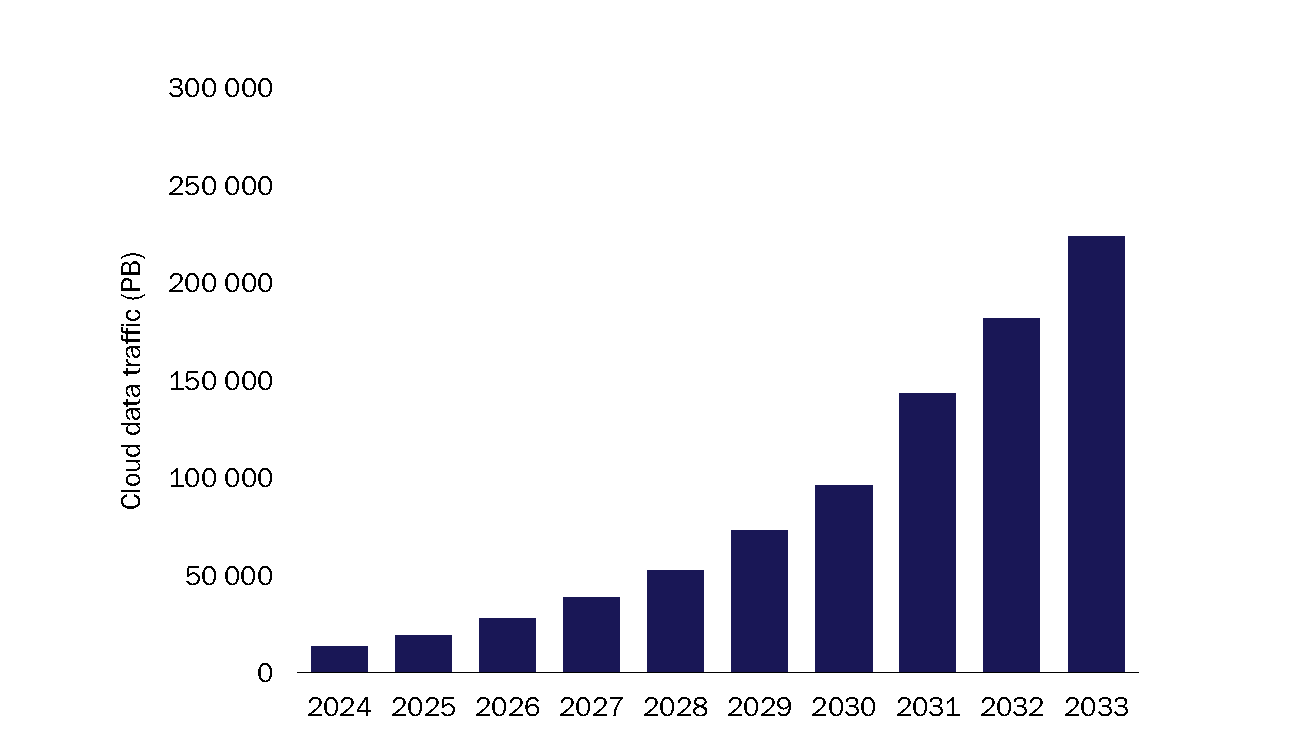
Much of the initial demand for orbital DCs will come from low-Earth orbit (LEO) communications constellations, which Analysys Mason predicts will account for the greatest number of satellites built and launched in the next 10 years. The ability to route traffic efficiently through gateways or via intersatellite optical links is a major use case for space-based DCs, and the trend towards software-defined satellites, where hardware is reconfigured using onboard computing, is expanding the use cases.
Later on, Earth observation platforms will become an important use case for orbital DCs; their ever-growing ground resolution payloads, space domain awareness for military organizations and commercial space stations are all generating huge datasets. Indeed, the ISS has already hosted several demonstrations, and Axiom Space has stated that it is building a DC for its private station to be launched in 2027.
The Low Earth Orbit (LEO) communications and Earth Observation (EO) markets will produce large amounts of data daily. The availability of local storage and processing will be much sought-after because it offers lower latency than raw data being downlinked to Earth.
Finally, beyond-Earth missions, chiefly on the Moon, will offer notable commercial and scientific value. These have historically been limited in terms of onboard storage and processing, so better computing capabilities are required for both security and sovereignty reasons.
Orbital DCs must meet stringent requirements
There are several issues that operators of orbital DCs must overcome to ensure a reliable and efficient service. Chief among them is thermal management. This is a major problem for DCs on Earth, and water is typically used. In the absence of water, advanced materials and thermal radiators are used for heat dissipation in space, but there are limitations due to the microgravity environment, especially for fluid-based heat transfer in larger infrastructure. This challenge, coupled with the limited usable power in space, mean that significant attention is needed when designing electronics for orbital computers.
Additionally, radiation from space can affect compute efficiency, and chips housed in orbital DCs have to overcome this challenge. This is expensive. Chips with no, or low, radiation hardness typically cost a few thousands of US dollars, but those will full radiation hardening can cost almost US$ 0.25 million. Software programs that monitor the health of components and ensure the delivery of reliable computing results, as well as providing security from cyber attacks, can be used to help to solve this radiation problem.
Orbital DCs must provide data redundancy if they are to match the capabilities of terrestrial DCs, but this is challenging given the limited resources in space, such as power. Data redundancy will also enhance both disaster recovery and business continuity, so is an important requirement for any DC.
The opportunity to store, process and transmit more data in orbit will be important for all users of space assets
All the signs are pointing to the expansion of computing in space via orbital DCs, but innovative solutions are required to develop DCs that will withstand the harsh environment of space.
As the orbital DC market expands, there will be more real estate and power, as well as better heating management; this will improve the value proposition of DCs in space. Thus, we can foresee a day when orbital DCs housing several tens, if not hundreds, of servers will serve important assets in space for ever-more-complex missions. However, there are challenges that are inherent to the space environment that must be addressed from the outset to make this a viable market.
Analysys Mason’s Emerging space applications and Earth Observation programs have more research and insights into the orbital DC market. For more information go to www.analysysmason.com
-----------------------------------

Claude Rousseau is Research Director at Analysys Mason. Based in France, he is a regional and applications expert and directs both multi-client research reports and consulting projects. He has more than 30 years of experience in the space sector in organizations such as the Canadian Space Agency (CSA), the International Space University (ISU), Futuraspace and NSR which he joined in 2006. He received a BSc. (Physics and Astrophysics) from the University of Calgary (Canada) and an MSc. (Space Science) from the International Space University (France) with where he is currently also Adjunct Professor in business and management. He can be reached at: claude.rousseau@analysysmason.com