



by Hub Urlings
Amsterdam, the Netherlands, September 3, 2026--Despite years of bullish forecasts and expectations built up over the last few years, satellite Internet of Things (IoT) in 2026 is still far from the transition from promise to commercial maturity. The industry is no longer dominated by marketing-induced visions of fleets of inexpensive CubeSats connecting billions of sensors across the planet. Instead, the reality is a steadily growing market for critical communications served by a handful of incumbent players. Facts speak for themselves. Around 80% of today’s market remains in the hands of incumbent mobile satellite operators such as Viasat/Inmarsat, Iridium, ORBCOMM, and Globalstar.
Alongside them, however, a diverse group of challengers are pursuing new ways to capture the next phase of growth. These challengers include specialist Low-Power Global Area Networks (LPGANs) using CubeSats, operators using capacity on existing satellites, 3GPP-based Non-Terrestrial Network (NTN) providers, and companies combining terrestrial and satellite connectivity. Although still a small part of the market, these different approaches are triggering the emergence of a broader connectivity ecosystem for satellite IoT.
Despite the fact that big expectations have not been met, the market has reached meaningful scale. Berg Insight’s forecasts extrapolated a base-case estimate of around 12 million active satellite IoT terminals or subscriber connections in 2026. Connectivity revenue is approximately US$ 0.8–1.0 Billion, while the broader ecosystem—including terminals, modules, installation, platforms, and managed services—approaches US$ 2 Billion. Berg Insight forecasts 32.5 million satellite IoT connections by 2029. Such figures should be treated with caution, however, as is the case with all spreadsheet logic. Market definitions are not clear, ie. is Artificial Intelligence Systems (AIS) part of satellite IoT?, and, most importantly, satellite operators disclose little useful data when it comes to subscriber numbers.
A Two-Track Market
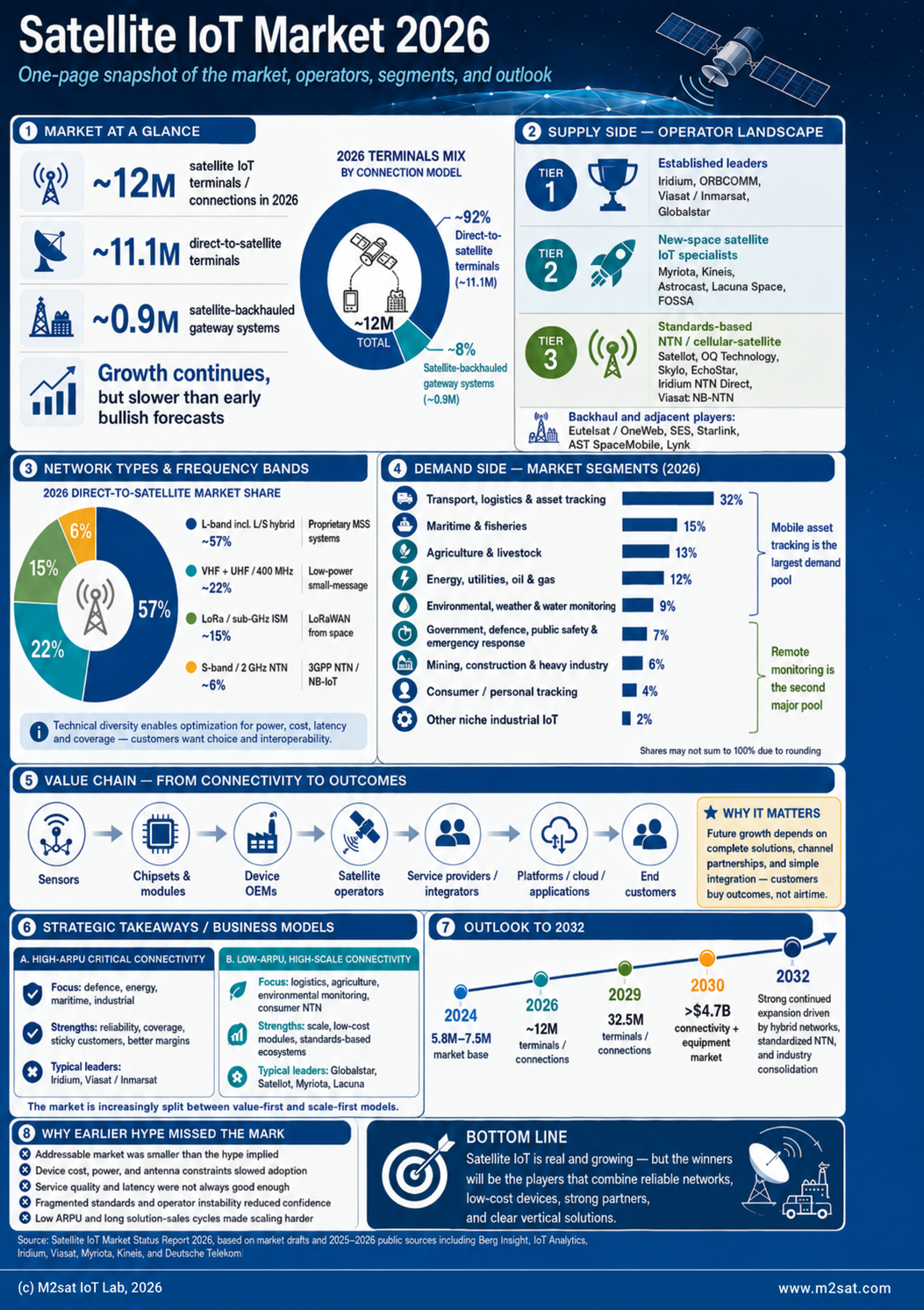 Behind the headline numbers, satellite IoT is developing on two distinct economic tracks.
The first consists of high-value, mission-critical communications for defense, maritime operations, energy, utilities, mining, trucking, and heavy industry. Customers in these sectors require reliable communications regardless of location, particularly where terrestrial infrastructure is unavailable, unreliable, or cannot be trusted. Global coverage, security, service continuity, and long equipment lifecycles are more important than achieving the lowest possible price per connection.
The second track addresses potentially much larger numbers of devices but at much lower average revenue per user. Environmental monitoring, agriculture, livestock management, logistics, asset tracking, and eventually consumer applications could generate tens of millions of connections. Yet these markets become economically attractive only when terminals are inexpensive, power consumption is extremely low, and satellite connectivity can be integrated almost invisibly into existing IoT solutions.
This distinction helps explain the continuing strength of the incumbent operators. Iridium(just recently acquired by RocketLab), Viasat/Inmarsat, Globalstar (acquired by Amazon LEO), and ORBCOMM possess advantages that new entrants cannot easily reproduce: operational global networks, spectrum rights, mature hardware ecosystems, installed customer bases, distribution networks, and decades-long relationships with industrial and government customers.
Nor are these incumbents standing still technologically.
Iridium provides a particularly good example. In June 2026, it introduces the Iridium 9604, combining Short Burst Data satellite communication, LTE-M cellular connectivity, and Global Navigation Satellite System (GNSS) positioning in a single module. A tracking device can therefore communicate through LTE-M while terrestrial coverage is available and switch to satellite when it moves beyond that coverage.
At the same time, Iridium maintains its established proprietary ecosystem, develops higher-capacity messaging through Certus and Iridium Messaging Transport, and prepares NTN Direct for standards-based connectivity. Instead of choosing between proprietary satellite technology and 3GPP NTN, Iridium is positioning itself across both worlds. Its collaboration with SKYWAVE, an ORBCOMM company, reinforces this direction, combining satellite, cellular, and Wi-Fi connectivity within a multi-network environment.
Challengers Search for Their Position
For the next-gen operators, the challenge is more difficult. Companies such as Myriota, Kinéis, Sateliot, Lacuna Space, and FOSSA cannot compete simply by putting cheaper satellites into orbit. The most lucrative established markets are already taken and heavily defended by the incumbents.
Their opportunity lies in markets where lower-cost terminals, very low power consumption, new network architectures, and new distribution models can unlock applications that traditional satellite economics have struggled to serve. But technology alone is not enough. The challengers must also establish commercial ecosystems of service providers, systems integrators, and support organisations capable of addressing fragmented markets such as agriculture, environmental monitoring, and asset tracking.
Kinéis illustrates the specialist approach. Its 25-satellite constellation, building on the heritage of the Argos system, focuses on applications where very small messages, extremely low power consumption, and long battery life matter more than integration with mainstream cellular infrastructure. Environmental monitoring, maritime applications, livestock management, infrastructure surveillance, and wildfire detection fit naturally into this model.
The 3GPP NTN operators pursue a different strategy. Sateliot is perhaps the clearest example, designing its satellites as extensions of terrestrial NB-IoT networks. Its growing relationships with operators including Telefónica, Telenor IoT, and Turkcell point toward a fundamentally different distribution model. An enterprise customer may eventually obtain terrestrial and satellite IoT through the same mobile operator, SIM, and service contract rather than purchasing satellite connectivity separately.
A third model avoids the cost of building a dedicated constellation altogether. Companies such as Skylo use capacity on existing satellite infrastructure, while Myriota’s HyperPulse similarly uses Viasat L-band capacity for its 3GPP Release 17-based NTN service. In this model, competitive advantage increasingly comes from network orchestration: determining how a device authenticates, is provisioned, and moves between terrestrial and satellite networks.
This approach potentially reduces the enormous capital burden of owning a constellation and shifts value toward the connectivity-management layer. Yet the difficulties facing newcomers remain evident. Some early players have disappeared, stalled, or diversified into other markets, while companies such as FOSSA and Fleet have broadened their activities beyond satellite IoT.
From Constellations to Complete Solutions
The economics explain much of this consolidation and diversification. Agriculture, environmental monitoring, and mass asset tracking can create huge numbers of connections, but revenue per device remains modest. Building and operating satellites, ground infrastructure, and a global commercial organization purely on low-value connectivity revenue is challenging.
This also explains why earlier market forecasts have repeatedly proved too optimistic. The theoretical population of unconnected assets is enormous, but the commercially addressable market is smaller. Hardware cost, antenna requirements, battery limitations, intermittent coverage, proprietary technologies, and long enterprise sales cycles all slow adoption.
Success therefore depends on much more than placing a technically capable constellation into orbit. Satellite IoT requires a complete value chain extending from sensors and chipsets through modules, satellites, and network provisioning to cloud platforms, analytics, applications, distribution, and lifecycle support.
The satellite IoT market of 2026 is consequently developing along two tracks. The incumbents and their ecosystem partners continue to dominate high-value critical communications in defense, maritime, mining, transport, energy, and utilities—a market likely to grow further as geopolitical uncertainty increases demand for resilient and sovereign communications.
On a parallel track, a much broader group of challengers is pursuing the emerging volume markets of agriculture, environmental monitoring, asset tracking, and new SME and consumer applications. Among these companies, the 3GPP NTN players appear particularly well positioned because they can partner with terrestrial mobile operators rather than create an entirely separate satellite distribution ecosystem.
Whether this second track finally achieves the long-anticipated scale remains the central question.
When it does, it will mark an important threshold in the history of satellite IoT, when the two tracks merge and satellite connectivity evolves from a specialist communications service into an embedded component of global IoT—terrestrial whenever possible, satellite whenever necessary, invisible to the user.
--------------------------------------------
 Hub Urlings was one of the pioneers of Satellite M2M/IOT as Product Manager Inmarsat-C at the famous KPN Station 12. The success of this “small data” satellite service, its global coverage, and its reliability made Inm-C via our Burum ground station the service of choice for many applications, ranging from emergency communication at sea, contacting the HQ, sending messages to truck fleet management, pipeline monitoring, and collecting data from all types of sensors. Now, 25 years later, he is involved in developing satellite IoT applications for environmental monitoring. His company, M2sat.com, focuses on satellite IoT Hydro-Met solutions using the M2sat IoT Communicator, a low-power edge processor and satellite IoT network-agnostic connectivity hub. In 2022, he founded SatIoTlab.com as a research, education, and co-creation platform for global satellite IoT applications. SatIoT.lab operates a test bench with active Sat IoT modems from five different networks. He can be reached at:urlings@m2sat.com