Media software solutions provider today announced new leadership in the form of Sam Kamel as CEO and Fred Fourcher as Chairman. This marks a return for Bitcentral founder Fourcher, evolving Bitcentral from an essential software platform for nightly news preparation to a leading company in streaming media. Under Fourcher's guidance, Bitcentral will continue to redefine audience engagement, offering scalable solutions from traditional broadcast newsrooms to dynamic streaming online talk shows.

Hanwha Phasor, a UK-based satellite communications company, has announced two new key hires as part of the business’ expansion into the US market. Richard LePage joins the organization as a Business Development Director, United States Government (USG), and Scott McCobb joins as Hanwha Phasor’s Commercial Director, Aviation – both positions will include a seat on Hanwha Phasor’s leadership team.
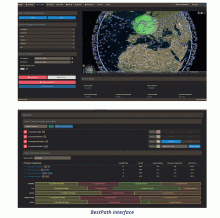
INTEGRASYS launches BestPath a new tool that allows to select in operation or simulation of all possible connectivities and prioritize and switch for maximizing resiliency. INTEGRASYS launches BestPath for automating the path selection under acquisition or service disruption due to ENI, cyber power outage, or catastrophes as well as speeding the user enablement process and ensuring resiliency seamlessly. BestPath is a fast and easy-to-use disruptive technology, based on INTEGRASYS Enterprise Management & Control becoming an essential module for maximizing service in congested environments.
Iridium Communications Inc. (NASDAQ: IRDM), today announced that it had entered into an agreement to acquire Satelles, a provider of highly secure satellite-based time and location services that complement and protect GPS and other GNSS-reliant systems.This acquisition continues Iridium’s philosophy of investing in differentiating technologies uniquely suited to its network that significantly outperform competing solutions according to the company.
In the face of unprecedented global environmental challenges, the Internet of Things (IoT) has the potential to be the catalyst in driving sustainable development. Satellite IoT, a means of communicating with very remote assets and sensors, holds tremendous potential in monitoring, managing, and mitigating environmental issues.
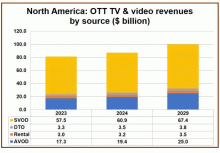
North American OTT TV episode and movie revenues will reach US$ 100 billion in 2029; up from US$ 81 billion in 2023. The US will contribute US$ 16 billion from the US$ 19 billion additional revenues, with Canada supplying the rest. US revenues will be $92 billion in 2029 according to Digital TV Research.
Readers of this magazine will know that behind (or rather, above) many areas of modern life is satellite technology. 5G phone networks. Location tracking. Precision farming. Disaster prevention and response. Without satellites, next to none of this could exist or exist at the level of sophistication we enjoy now. The technology is so deeply integrated into modern life that if all the world’s satellites were to vanish tomorrow, we would be in serious trouble. And it’s why, despite the volatility of the past few years, the industry has continued to expand. In 2024, we can expect another big year.
In 2017, North Korea shocked the world by launching tests of two ballistic missiles able to cross the Pacific and strike the US. One just missed hitting a commercial passenger flight headed for Tokyo.
The UN Security Council slapped a severe penalty on the rogue nation: a limit on the amount of fuel and crude oil it could import. The hope was that, with no oil reserves of its own, North Korea would soon feel the pressure to change its ways.
Except it didn’t. Two years later, the country conducted no fewer than 20 missile tests. What went wrong?