





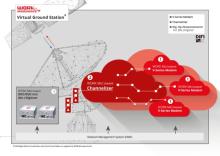
WORK Microwave, one of the leading manufacturers of advanced satellite communications equipment, launched recently its cutting-edge Virtual Ground Station® (VGS).

Gilat Satellite Networks Ltd. (Nasdaq: GILT, TASE: GILT), a provider of satellite networking technology, solutions, and services, announced today that Nicole Robinson has been appointed as President of DataPath.
Looking at recent developments in the satellite market in the Middle East, two words spring to mind: growth and partnerships. In a white paper “Beyond the Stars,” written for the Sultanate of Oman, Novaspace (formerly Euroconsult)describes the Middle East as a “global hotspot for space activities.” The space economy in the region has tripled in the last decade to an estimated value of US$ 25 billion in 2023, and is expected to reach US$ 75 billion by 2032.
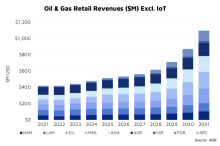
Providing connectivity to the oil and gas industry remains a significant market for satellite operators and service providers around the world, and nowhere more so than in the Middle East where a significant portion of the world’s oil and gas deposits are located. However, satellite is not confined to providing service to offshore locations; terrestrial pipelines, refineries and storage facilities, particularly those in remote locations, may also be served by satellite.

Imagery and video now account for over 80% of the world’s online content. Video experts and everyday video consumers alike agree that today’s connected content requires more robust networks. Consequently, video compression and encryption are now essential to modern communication infrastructures.

If you happen to be driving in Iceland admiring its celestially-favored coastal landscape with deeply indented by bays and fiords, you will notice, as you head toward the inland plateau, that along the straight road of a major highway you, your automobile and the highway will slowly but surely curve widely for no apparent reason. No danger in the landscape justifies this arching curveball thrown into the road.
But there’s a reason. An unexpected one.
CABSAT 2024 to highlight latest innovations in media and entertainment sectors, promises to transform industry's future
More...
CABSAT 2024, the premier conference for the broadcast, satellite, and content sectors, is slated to revolutionise media and entertainment with its innovative exhibitions and features for participants. The latest edition of CABSAT, starting from May 21 to 23, 2024, at Dubai World Trade Centre, will present innovative hall experiences for all attendees, while also highlighting cutting-edge technologies and diverse content offerings that will shape the future of the entertainment landscape.

/PRNewswire/ -- LightRidge Solutions, a leading provider of U.S.
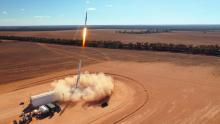
For the first time, a German company has successfully launched a commercially viable launch vehicle. At the Australian launch site in Koonibba, HyImpulse, a German manufacturer and system provider of commercial launch vehicles for satellite transport, successfully test-launched the 12-metre-long and 2.5-tonne single-stage rocket "SR75", which can transport small satellites weighing up to 250 kg to an altitude of around 250 km. At 14:40 PM ACST or 7:10 AM CET, the launch vehicle lifted off successfully and the hybrid rocket propulsion system of the launch vehicle operated as planned.
