Significant and ongoing transformations in the High Throughput Satellites (HTS) market are confirmed in the 7th edition of the 'High Throughput Satellites' report from leading space consulting and market intelligence firm Novaspace, a merger between Euroconsult and SpaceTec Partners. The report underscores the pivotal role of Non-Geostationary Orbit (NGSO) constellations in reshaping the satellite connectivity industry, with the latter to emerge as the primary driver in coming years.

Iridium Communications Inc. (Nasdaq: IRDM) (“Iridium”), a leading provider of global voice and data satellite communications, today reported financial results for the first quarter of 2024 and reiterated its full-year 2024 outlook. Net income was $19.7 million, or $0.16 per diluted share, for the first quarter of 2024, as compared to net income of $9.8 million, or $0.08 per diluted share, for the first quarter of 2023. Operational EBITDA (“OEBITDA”)(1) for the first quarter was $115.0 million, as compared to $111.9 million for the prior-year period, representing a year-over-year increase of 3%. Net income benefitted from a year-over-year decrease in depreciation expense associated with the extension of the estimated useful lives of the Company’s satellites and continued growth in total commercial services revenue.
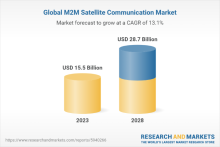
The global M2M satellite communication market is valued at USD 15.5 billion in 2023 and is estimated to reach USD 28.7 billion in 2028, registering a CAGR of 13.1% during the forecast period. The growing demand for monitoring and remote management of connected devices stands as a pivotal market driver propelling the growth of M2M satellite communication. As the world becomes increasingly interconnected through the IoT, industries and enterprises are deploying a myriad of connected devices across diverse sectors, such as agriculture, healthcare, transportation, and manufacturing. This surge in connected devices necessitates efficient and reliable communication channels, especially in remote or inaccessible locations where traditional networks may be unreliable or unavailable. M2M satellite communication emerges as a solution to bridge these connectivity gaps, ensuring seamless data transmission and control over dispersed and geographically distant devices. The ability to monitor, track, and manage these devices remotely enhances operational efficiency, reduces downtime, and enables timely decision-making.
The satellite communications market has seen significant changes across its value chain, bringing forth new technological innovations that include flexible satellites and more specifically, Software-Defined Satellites (SDS). Geostationary Earth Orbit (GEO) satellite operators have been compelled to respond to increased competition amidst these market shifts. One approach is to optimize the utilization of GEO satellites; however, the rigidity and fixed capacity of traditional GEO satellites is a notable constraint. Therefore, the advent of flexible satellites presents an attractive solution to a variety of problems.