

Integrasys has released a new service offered for Beam Budget users providing a new remote database that gathers all of the Satellite Footprints.
Europe, Middle East and Africa Markets
The 1960s ushered in an era of human space exploration that has never been equaled. Humans traveled farther from our planet than ever before – not once but half a dozen times – and those journeys sparked the dreams and ambitions of millions. And then we stopped. We flew robots to other planets. We put satellites and space stations into orbit. But people never again answered the call to leave our planet far behind in a quest for knowledge and opportunity, to open new horizons for others to follow.
Never – until now.
Many years ago, when I was part of a team considering an investment in Teledesic, one of the engineers at Hughes, produced a computer model, of what would happen if one of the satellites ran into a piece of orbital debris. The assumption was, that this would cause it to break-up, so the satellite behind would inevitably run into the fragments and similarly break-up and so on. The space equivalent of a freeway pile-up, technically known as the Kessler Effect, after the NASA scientist who first modeled this happening.
Microsatellites and nanosatellites are miniaturized man-made satellites that are used for collecting information about the earth and space, among other uses. According to NASA, these satellites are classified on the basis of their overall mass. Microsatellites are artificial satellites, with a mass of 11–100 kg (including fuel mass) while nanosatellites are artificial satellites weighing between 1 and 10 kg, and measuring around 30 cm × 10 cm × 10 cm. Nanosatellites with standard dimensions (“U” or Units) of 10 × 10 × 11 are known as CubeSats.
Depending on where you are in the world today, the light at the end of the tunnel is either welcome daylight or an oncoming train. Since it first appeared in late 2019, COVID-19 has been an unequal opportunity curse, killing many, sickening more and leaving even more of us untouched but isolated and afraid. Now that vaccines are pouring out of production facilities and into people’s arms, the inequality has actually grown, varying from nation to nation based on economic might, the capabilities of governments and national and regional culture.
NSR’s Land Mobile via Satellite, 9th Edition (LMvS9) report, released today, forecasts despite some challenges with enterprise segments over the past 16 months, consumer handheld demand soared throughout 2020, after challenges at the start of the year. LMvS9 finds this solid base propelling the market to add over 500,000 new land mobile subscribers over the coming decade, reaching 1.2 million active subscribers in 2030.
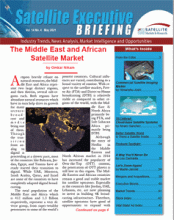

The May2021 issue of the Satellite Executive Briefing magazine focusing on the Middle East and Africa Satellite Market is now available. Featuring:
 UltiSat, a global provider of critical communications solutions, announced today that Tim Smith has joined the company as its new Vice President and General Manager of Wireless Solutions.
 |
| Integrasys' office at the Nassima Tower, Dubai Trade Center district |
Integrasys maintains its aggressive expansion plans by opening a new high-tech office at the
A summary of the innovative features and benefits of ST Engineering iDirect's new Mx-DMA Multi-Resolution Coding (MRC) Technology.
To read or download the pdf of full report click here.