

The Satellite Industry Association (SIA) released the 2019 State of the Satellite Industry Report at an industry briefing as part of the SIA-organized Government and Military Forum at the SATELLITE 2019 conference and exhibition in Washington, DC. SIA’s 22nd annual industry report, produced by Bryce Space and Technology, LLC, is derived from proprietary surveys of satellite companies, in-depth public information, and independent analysis which are combined to assess the performance of key satellite industry sectors including satellite services, manufacturing, ground equipment and
Europe, Middle East and Africa Markets


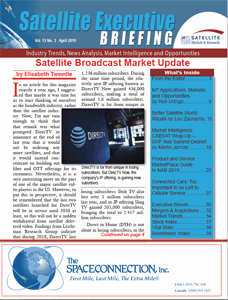 The April 2019 issue of the Satellite Executive Briefing magazine focusing on the Satellite Broadcast market sponsored by The SpaceConnection
Aberdeen & London: Oilfield Connectivity & Cellular Backhaul on GVF’s Satellite Conference Agenda
More... The satellite industry calendar for May and June 2019 will see two key events from the GVF-EMP Conference Partnership portfolio taken firstly to Aberdeen in Scotland and then to London.
Eastern Europe will have 26.19 million SVOD subscriptions by 2024; up from 10.02 million recorded by end-2018. Russia will supply 8.77 million to the 2024 total, with Poland bringing in another 6.32 million. Together, they will account 58% of the region’s total.
New research from Parks Associates finds that the percentage of UK broadband households stating that they are likely to cancel their pay-TV service has increased to 24% in late 2018 from 12% in late 2015. IoT in the UK - Entertainment Products and Servicesreports that the intent to cancel is higher among households that watch online video services.
Telesat reported consolidated revenues of US$164.85 million (Ca$222 million) during the first quarter of 2019, a decrease of 4% or US$7.43 million (Ca$10 million) compared to the same period in 2018. But despite the drop, Telesat netted US$127.72 million (Ca$172 million) compared to a loss of US$11.14 million (Ca$15 million) in first quarter 2018.
It started with Iridium and Globalstar, the first satellite constellations. When Iridium began designing a 66-satellite system and Globalstar specified 48 spacecraft, the companies faced a completely new need: to standardize on a single design and produce it in quantity.
Then in this century, O3B (now SES Networks) became the next company to build and launch a constellation. O3B was followed by OneWeb, and soon constellations were in development by Telesat, LeoSat, SpaceX, Boeing and other operators both long established and brand new.
Conviva’s State of Streaming TV Industry: Overall Viewership Up 72%, Rate of Consumption Rising Faster at 49%
More...Conviva, a research firm that specializes on the streaming entertainment industry, has concluded that while adoption of streaming is increasing, so is the complexity of achieving the goal of seamless video delivery at scale. In its "State of the Streaming TV Industry for First Quarter 2019," Conviva said that maintaining a high-quality viewer experience across content and advertising is critical as streaming TV providers look to increase viewer retention and monetization.
The world is full of sharp disparities between the privileged and those struggling for access: access to good work, to knowledge, to the means to pursue their calling and preserve their communities. Around the world, dedicated people are using technology to close that gap. Technology that is literally out of this world.
Building a Better Future in Africa