

Europe, Middle East and Africa Markets

In today’s rapidly evolving digital landscape, ensuring seamless and reliable connectivity is paramount, especially for mobile platforms. This case study explores the integration of a VSAT (Very Small Aperture Terminal) mobility network on vehicles, designed to provide robust cellular backhauling for private data networks and general internet connectivity. The system leverages an innovative blend of satellite and terrestrial technologies to deliver continuous and high-speed connectivity to serve the needs of Government and VIP users.

System Overview

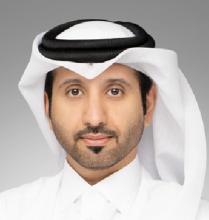
Satellite Markets and Research Editor-in-Chief Virgil Labrador spoke with  Eng. Abdulaziz S. Alfarraj, CEO of  NSG Geospatial Services on their company's geospatial capabilities. With over 24 years of experience in leadership roles within the geospatial and technology sectors, Abdulaziz S. Alfarraj has been at the forefront of advancing Saudi Arabia’s capabilities in Geospatial, Earth Observation, and Remote Sensing technologies.

Decision makers and policy pioneers from the space sector will gather in Dubai to discuss trends and challenges in the new space economy at SATExpo Middle East 2025, which takes place from May 13 to 15, 2025, at the Dubai World Trade Centre (DWTC).

The two-day event’s summit will look at how satellites can transform life on earth, with topics including ‘Space Technology Adoption in Emerging Markets,’ ‘The Road to In-Orbit Sustainability,’ ‘AI’s Role in Transforming the Use of Satellite Data,’ and more.

Ibrahim Abdulla Al-Hammadi.jpg

Ibrahim Abdulla Al-Hammadi


Es’hailSat, the Qatar Satellite Company, has expanded its channel offerings by incorporating two channels from Misk Media into its video distribution lineup at the 26° East orbital position, facilitated by the Es’hail-2 satellite. The Es’hailSat satellite footprint strategically encompasses the Middle East and North Africa (MENA) region, optimizing signal coverage and enabling significant viewership potential for both channels from Misk Media throughout this expansive area.

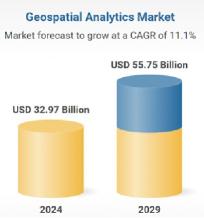
Investment in geospatial technologies continues to grow at a rapid pace.  According to NovaSpace, an estimated 5,401 earth observation satellites will be launched between 2024 and 2033.  This is a 190% increase from the 1,864 satellites launched in the previous decade.  This growth is being fueled by technological innovation and increased demand.  As climate change, migration, urbanization and conflicts increase, the need for timely and precise geospatial information continues to grow.  

Es’hailSat, the Qatar Satellite Company, has expanded its channel offerings by incorporating Syria’s Al-Ikhbariya TV channel into its video distribution lineup at the 26° East orbital position, facilitated by the Es’hail-2 satellite. The Es’hailSat satellite footprint strategically encompasses the Middle East and North Africa (MENA) region, optimizing signal coverage and enabling significant viewership potential for the public broadcaster’s channel from General Organization for Radio and Television throughout this expansive area.

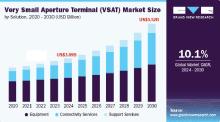
According to Novaspace, in 2022 there were 5.6 million commercial Very Small Aperture Terminals (VSATs) in use around the world.   Novaspace is forecasting a 2.3x growth rate in this number to 2032, meaning there will be 12.88 million commercial VSATs in use that year.  It is also forecasting a cumulative market value for the entire ground system (i.e. not just VSATs) of US$ 80 billion between 2023 and 2032.