



Global Markets - Market Trends
The 25th Edition of Novaspace’s Government Space Programs report notes a US$ 137.4 Bil. government space market in 2025, signaling a structural shift toward defense-driven investment and commercial procurement models. Defense now accounts for 54% of global spending (US$ 73.5B), surpassing civil budgets (US$ 63.7B) and cementing space as a core national security domain alongside land, air, maritime, cyber, and information.
by Elisabeth Tweedie
When SpaceX launched Starlink in 2019, the industry changed forever. Geosynchronous satellites (GEOs) had long been the dominant, indeed until the launch of O3b service in 2014, the only way, to access commercial space-based broadband communication services. The first generation of O3b, a medium-earth orbit (MEO) constellation had limited capacity and only served a small segment of enterprise satellite users. Starlink as a low-earth orbit constellation (LEO), offered a very different service. Due to significantly increased capacity provided by thousands of satellites, coupled with the lower bandwidth prices made possible by a vertically integrated supply chain, consumer broadband service became a viable service from non-geostationary satellites (NGSO). However, with service being provided on a “best effort” basis, few enterprise customers were interested.
According to MarketsandMarkets™, the Generative AI Market is anticipated to register a compound annual growth rate (CAGR) of 43.4% over the course of the forecast period, reaching US$ 890.59 billion by 2032 from an estimated US$ 71.36 billion in 2025
Novaspace’s Capacity Pricing Trends, 8th Edition finds the satellite connectivity market has entered a Post‑Capacity Era, where bandwidth is no longer the basis of differentiation. Starlink’s vertical integration and cost compression are accelerating this shift, resetting competitive expectations across the sector.
A new report by the Computer & Communications Industry Association’s Space and Spectrum Policy Center outlines how reforms to our outdated space launch policy could propel the commercial space economy to new heights. Recent innovations in space technology have created new opportunities for commercial space activities, such as space-based data services, remote sensing, in-space manufacturing, commercial space stations, and lunar activities. While launch companies are introducing new vehicles capable of delivering larger payloads at a higher cadence, they encounter multiple challenges along the way.

The 12th edition of Novaspace’s Space Economy Report notes the global space economy is now on a significant growth trajectory, positioned to expand from $626.4 billion in 2025 to $1.01 trillion by 2034, a significant 12% CAGR. While growth continues to be supported by innovation, new business models, assertive government policies and expanding demand for satellite-enabled services, 2025 stands out as a structural inflection point, marking a transition from rapid expansion toward a more mature and structured space market.
Rethink TV, from Rethink Technology Research, has published its latest report: "Content Development Networks (CDN) Market Forecast 2026-2031".

Enterprise Management Associates (EMA™), an IT research and consulting firm, has released a new research report, "AI-Driven NetOps: How Enterprises are Embracing Intelligent Network Management Solutions," authored by Shamus McGillicuddy, vice president of research for network infrastructure and operations at EMA.
by Blaine Curcio
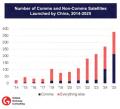
t’s been a wild year in China’s satellite communications (satcom) market. The country has seen rapid growth in the number of comms satellites launched, a host of regulatory developments in the Direct-to-Device (D2D) and Non-Terrestrial Network (NTN) space, and jockeying for position among two major Non-Geostationary Orbit (NGSO) projects. The three main themes of 2025 have been the ascendance of China SatNet, question marks surrounding SpaceSail, and Geostationary Orbit (GEO) being used for all sorts of creative things. For a whole lot more information on China’s NGSO constellations, get in touch about the China NGSO Constellations Report, published by Orbital Gateway Consulting in December 2025.
Traditionally, the mission profile and business model for satellites was determined by the operators and customers before the manufacturing process began. This approach was successful for decades, but the transformation of the communications sector requires the satellite world to evolve as well. Going forward, the flexibility of software-defined satellites (SDS) promises to transform how satellite operators design, deploy and manage space segment.