

Western Europe will have 191 million SVOD subscriptions by 2025; more than double from 90 million at end-2019. About 35 million subscribers will be added in 2020 alone, with the Covid lockdown having a major effect according to Digital TV Research.
The 2020 Edition of African Space Industry Annual Report has been released by Space in Africa. The report provides analyses on the growing demand for space technologies and data on the continents, the business opportunities it offers and the necessary regulatory environment in the various countries. The report also contains information on all 69 pending satellites from Africa between now and 2024.
Conviva repeased today the State of Streaming report focusing on Asia. While the world’s increase in viewing time raced ahead 63% in Q2 2020, Asia recorded the smallest gains, inching up 2% over the previous year, according to the report. Some of the highlights of the report's findings include:
Amid the COVID-19 crisis, the global market for Commercial Satellite Imaging estimated at US$4.4 Billion in the year 2020, is projected to reach a revised size of US$8.3 Billion by 2027, growing at a CAGR of 9.4% over the analysis period 2020-2027. Military & Defense, one of the segments analyzed in the report, is projected to record a 10% CAGR and reach US$3.9 Billion by the end of the analysis period.
There will be 27.16 million paying SVOD subscriptions for 20 countries in the Middle East and North Africa by 2025, up from 10.95 million recorded at end-2019 according to Digial TV Research. Turkey will remain the country leader, with 11.30 million subscriptions by 2025.


In its latest research, Prospects for In-Flight Entertainment and Connectivity, Euroconsult provides a strategic review of the market reset resulting from the COVID-19 pandemic and its significant impact on the aviation industry. In-Flight Connectivity (IFC) has been a key driver for the entire ecosystem and constituted a $1.4 billion market in 2019.
"Over-the-top (OTT) streaming services overtake cable and satellite viewing in USA.” “More Netflix viewers than Sky satellite TV viewers in the UK.” As you read headlines like these, it would be easy to think that satellite, not only as a Direct-to-home (DTH) service, but also as a content delivery provider has lost its place in the value chain. Nothing could be further from the truth. There are many reasons why satellite will continue to be both necessary, relevant and indeed an essential partner for key players in the OTT industry, and this MarketBrief will examine the key ones.
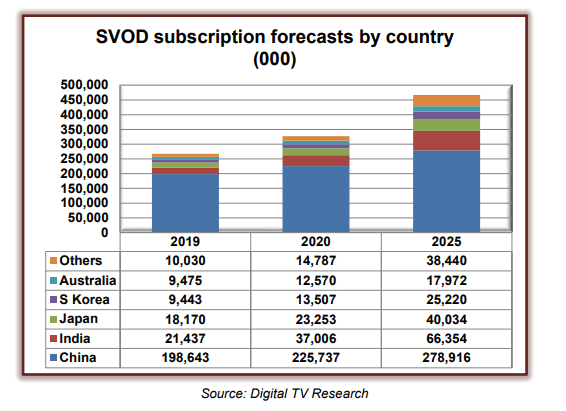 The Asia Pacific region will have 467 million SVOD subscriptions by 2025, up from 267 million in 2019. China will contribute 279 million SVOD subscriptions in 2025 – or 60% of the region’s total. India will supply a further 66 million – triple its 2019 total according to Digital TV Research.
 Where does high quality of service come from in a satellite services operation that runs 24x7? There are obvious factors like the reliability of power and connectivity, provision against disaster like fire suppression and adequate attention to maintenance. But quality of service is ultimately a product of human ingenuity, and its roots reach into t