



Americas Markets - Market Trends
Global satellite services revenues are forecast to grow 44% to reach US$145 billion by 2035, according to the 33rd edition of Novaspace’s Satellite Connectivity and Video Market report. The next decade will mark a fundamental shift in the industry as data services become the dominant growth engine, driving revenues to nearly $100 billion by 2035.
The global CubeSat market was valued at US$ 512.6 million in 2025 and is estimated to grow at a CAGR of 14.4% to reach US$ 2 Billion by 2035, according to a recent report by Global Market Insights Inc.
New industry analysis projects strong growth in the Low Earth Orbit (LEO) satellite constellation market through 2034 as operators expand broadband networks, governments develop sovereign satellite systems, and emerging technologies create new opportunities in direct-to-device connectivity and orbital services.
Novaspace’s Satellite Communications for Defense and Security, 2nd Edition highlights a defense Satcom market poised for rapid growth. By 2035, commercial satellite service revenues are projected to exceed US$22.6 Billion, while global defense Satcom demand is forecast to surpass 7.5 Tbps, driven by the adoption of next-generation non-geostationary orbit (NGSO) constellations.

The World Teleport Association (WTA) today released The AI-Driven Teleport, a new research report that explores where teleport and satellite operators were deploying generative AI in their customer-facing, engineering and operations departments in 2024, and what results they were seeing so far from investment in a still-emerging technology. They were using it to automate marketing and customer service and assist with code development and cybersecurity. They were buying standard business services from third parties and building their own systems to manage unique needs, based on past experience with machine learning.

Despite years of bullish forecasts and expectations built up over the last few years, satellite Internet of Things (IoT) in 2026 is still far from the transition from promise to commercial maturity. The industry is no longer dominated by marketing-induced visions of fleets of inexpensive CubeSats connecting billions of sensors across the planet. Instead, the reality is a steadily growing market for critical communications served by a handful of incumbent players. Facts speak for themselves. Around 80% of today’s market remains in the hands of incumbent mobile satellite operators such as Viasat/Inmarsat, Iridium, ORBCOMM, and Globalstar.
by Aishwary Pachauri
For decades, government space budgets were viewed mainly through civil ambition: lunar and Mars missions, Earth observation, human spaceflight, science, and national prestige. Agencies such as NASA, ESA, JAXA, ISRO, Roscosmos, and CNSA shaped this public narrative. That story still matters, but it no longer captures the full picture. Between 2021 and 2026, military space organizations became some of the fastest-growing budget centers in the global space economy.
by Bernardo Schneiderman
In 2026, the Internet of Things (IoT) and satellite markets are converging into a phase of intelligent value creation, characterized by smarter automation and the mainstreaming of Direct-to-Device (D2D) connectivity. The satellite IoT market specifically is projected to reach approximately US$ 2.26 billion in 2026 as it transitions from a niche service to a core enterprise resilience strategy. During 2026 the satellite and IoT landscape is reaching a strategic "tipping point" where connectivity is no longer a technical hurdle but a standard foundation for operational intelligence. The market for satellite IoT alone is projected to reach approximately 32.5 million subscribers by 2029.
More than 6,500 Earth observation (EO) satellites are expected to launch by 2035, generating US$ 155.9 billion in manufacturing revenues as governments expand sovereign intelligence, surveillance, and reconnaissance (ISR) capabilities, according to the latest edition of Novaspace’s Earth Observation Satellite Systems report.
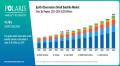
The global earth observation small satellite market is on track to expand from roughly US$ 2.14 billion in 2026 to $6.90 billion by 2034—a 15.76% compound annual growth rate according to Polaris Market Research. Buried inside that headline number is the more consequential trend: commercial end users are projected to grow at 17.3% annually, outpacing every other buyer segment, including the government programs that built this industry. For corporate strategists, investors, and procurement leaders, that inflection point—not the aggregate market size—is the number worth building a strategy around.